By Dave Henderson, 16 years in the ladder hitch rack and hitch-mounted cargo carrier industry, founder of a contractor outfitting shop in Denver, hands-on experience installing weight distribution hitches and trailer setups on over 500 contractor trucks and personal tow rigs, daily driver of a 2020 Ford F-250 with a Kargo Master Pro III hitch rack.
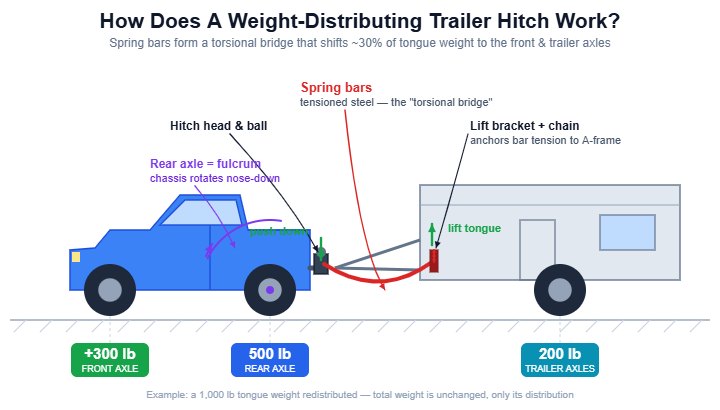
Spring bar leverage is the entire trick. A weight distributing trailer hitch uses two long steel bars anchored between the hitch head and the trailer A-frame to apply a lifting force at the tongue and a downward force at the receiver, rotating the tow vehicle around the rear axle and shifting roughly 30% of the tongue weight forward to the front axle and back to the trailer wheels.
Owners often picture the spring bars as “removing” the trailer weight, but no weight disappears. The 1,000 lb tongue weight that crushes a half-ton pickup’s rear suspension on a standard ball mount becomes 500 lbs on the rear axle, 300 lbs on the front axle, and 200 lbs transferred back to the trailer axles once the bars are tensioned correctly. To picture how does a weight distributing trailer hitch work, think of the bars as a torsional bridge between two vehicles, not a weight reducer.
What Is A Weight Distributing Trailer Hitch?
A weight distributing trailer hitch is a specialized hitch assembly that uses spring bars, a hitch head with trunnion or round-bar sockets, and adjustable chain hookups on the trailer A-frame to redistribute trailer tongue weight across the tow vehicle’s front axle and the trailer axles, rather than concentrating it on the rear axle alone.
This article covers weight distributing trailer hitches specifically, not standard ball-mount hitches, gooseneck hitches, fifth-wheel hitches, or pintle hitches. Each of those is a separate category with different load-distribution mechanics and use cases.
Weight distributing trailer hitches fall under the broader category of trailer towing equipment governed by SAE J684 hitch class standards. Most weight distribution systems require a Class III, IV, or V receiver because the leverage forces generated by the spring bars exceed Class I and II receiver tongue weight ratings.
The system has six main components:
The hitch head is the steel block that bolts to the ball mount shank and holds the trailer ball plus the spring bar trunnion or round-bar sockets. The Equal-i-zer 4-Point Sway Control hitch head, the Curt TruTrack hitch head, and the Reese Strait-Line hitch head are the leading designs.
The spring bars are the long steel rods (typically 28-32 inches) that anchor in the hitch head sockets and extend rearward along the trailer A-frame. The bars come in rated capacities (typically 600 lbs, 1,000 lbs, 1,400 lbs, 1,700 lbs) that must match the actual trailer tongue weight.
The lift brackets bolt to the trailer A-frame and provide the chain anchor points or L-bracket contact surfaces for the spring bar ends. The brackets transfer the spring bar tension into the trailer frame.
The chains or L-brackets connect the spring bar tips to the lift brackets. Older systems use heavy steel chains with multiple links for adjustment. Newer systems like the Equal-i-zer 4-Point and Andersen No-Sway use L-brackets or direct trunnion attachment for sway control.
The shank is the steel bar that inserts into the tow vehicle’s receiver tube. Most weight distribution shanks are 8-12 inches longer than standard ball mounts to accommodate the hitch head geometry.
The hitch pin and clip secure the shank to the receiver tube. Standard 5/8-inch hardened steel pins and hairpin retention clips are used.
On my own contractor truck setup, I run a Curt TruTrack 1,500 lb weight distribution hitch on my 2020 Ford F-250 when pulling a 7,200 lb enclosed equipment trailer. The hitch transformed the rig from a nose-up, light-steering, headlight-blinding setup to a level, planted, predictable tow.
The takeaway: a weight distributing trailer hitch is a 6-component leverage system that redistributes tongue weight across all four axles of the tow rig.
How Does The Spring Bar Leverage Actually Distribute Weight?
The spring bars create a torsional bridge between the trailer A-frame and the tow vehicle’s hitch receiver. When the bars are tensioned by raising the chain links or engaging the L-brackets, they apply an upward force at the trailer A-frame and a downward force at the hitch head, which rotates the tow vehicle’s chassis around the rear axle pivot point and transfers weight forward to the front axle.
The mechanical principle is third-class lever action with the rear axle as the fulcrum.
When you connect a 7,000 lb trailer to a half-ton pickup without weight distribution, the 700-1,000 lb tongue weight pushes down on the rear of the truck. The truck’s chassis pivots around the rear axle: the rear sags 2-4 inches, and the front rises 1-2 inches. This is called “squat” and it reduces front-axle weight by 100-200 lbs.
The reduced front-axle weight creates four problems. Front-axle braking effectiveness drops because the front tires have less weight to grip the pavement. Steering response becomes light and vague because the front tires have less grip. Headlight aim shifts upward, blinding oncoming drivers at night. And the truck’s rear suspension bottoms out on bumps because it is operating near the limit of travel.
The spring bars solve this by reversing the squat. When the trailer A-frame is chained or bracketed to the spring bar tips and the bars are tensioned, the bars try to straighten back to their natural shape.
The straightening force pushes down on the rear of the hitch head (which pushes down on the hitch receiver and rotates the tow vehicle nose-down) and pushes up on the trailer A-frame (which lifts the trailer tongue slightly). The combined effect rotates the tow vehicle around the rear axle, transferring 30% of the tongue weight forward to the front axle.
The math: a 1,000 lb tongue weight without distribution puts roughly 800 lbs on the rear axle and removes 200 lbs from the front axle (an 800/-200 distribution). With proper weight distribution, the same 1,000 lbs becomes roughly 500 lbs on the rear axle, 300 lbs on the front axle, and 200 lbs transferred back to the trailer axles (a 500/300/200 distribution). The total weight is the same; the distribution is dramatically different.
The 30% front-axle restoration is the engineering target. Most weight distribution hitches are calibrated to restore the front axle weight to within 1/2 inch of the unloaded ride height when properly adjusted.
On a 2018 Chevy Silverado 1500 I helped set up for a customer pulling a 6,500 lb travel trailer, the front axle weight dropped from 2,800 lbs unloaded to 2,650 lbs hitched (150 lb loss). After installing and adjusting an Equal-i-zer 4-Point hitch, the front axle weight returned to 2,790 lbs (only 10 lb difference from unloaded). The steering, braking, and headlight aim all returned to normal.
The takeaway: spring bar leverage redistributes tongue weight across the front axle, rear axle, and trailer axles by creating a torsional bridge that reverses the rear-suspension squat.
What Are The Main Types Of Weight Distribution Hitches?
The main types of weight distribution hitches are trunnion-bar hitches (Reese Dual Cam, Equal-i-zer 4-Point), round-bar hitches (Curt MV, Reese SC), and integrated sway-control systems (Andersen No-Sway, Blue Ox SwayPro, Curt TruTrack). Each design uses spring bar leverage but differs in sway control mechanism and adjustment complexity.
Here is a reference table of weight distribution hitch types and brand examples:
| Hitch Type | Sway Control Method | Brand Examples | Spring Bar Rating Range | Price Range |
|---|---|---|---|---|
| Trunnion-Bar | None (separate sway control) | Reese Steadi-Flex, Pro Series | 600-1,200 lbs | $350-$550 |
| Round-Bar | None (separate sway control) | Curt MV Round Bar, Reese SC | 600-1,400 lbs | $300-$500 |
| 4-Point Sway Control | Friction at L-brackets | Equal-i-zer 4-Point | 600-1,700 lbs | $550-$900 |
| Dual Cam | Cam-locking at A-frame | Reese Dual Cam High Performance | 800-1,700 lbs | $700-$1,100 |
| Friction Anti-Sway | Friction at hitch head | Curt TruTrack, Reese Strait-Line | 800-1,500 lbs | $600-$900 |
| Chain-Free / Tension | Threaded chain-free design | Andersen No-Sway WDH | 4,000-14,000 lbs trailer | $700-$1,000 |
| Air-Assist | Pneumatic spring assist | Air Lift LoadLifter, Hellwig | 600-1,200 lbs | $1,200-$1,800 |
The type selection depends on the trailer size, sway tendency, and budget.
Trunnion-bar hitches use spring bars that mount horizontally to the hitch head with trunnion sockets. The bars project rearward along the trailer A-frame. Round-bar hitches use vertical spring bar mounts that project downward and then rearward.
Both designs require separate sway control devices (typically a friction bar) for trailers over 4,000 lbs gross weight. The combined cost of a basic weight distribution hitch plus a friction sway control runs $400-$650.
4-Point Sway Control hitches integrate sway resistance directly into the L-brackets where the spring bars contact the trailer A-frame. The Equal-i-zer 4-Point is the dominant brand in this category with consistent results across most trailer sizes.
Dual Cam hitches use cam-locking mechanisms at the trailer A-frame that snap the spring bars into preset positions. The Reese Dual Cam High Performance provides the highest sway resistance and is preferred for trailers over 10,000 lbs gross weight.
The Andersen No-Sway WDH uses a unique chain-free design with adjustable tension brackets and a friction-bushing sway control built into the trailer ball. It is significantly lighter (around 60 lbs total) than traditional weight distribution hitches (often 100+ lbs), which makes hitching and unhitching easier for solo users.
Air-assist systems use pneumatic spring bars that adjust automatically based on tongue weight. They are the most expensive option at $1,200-$1,800 but eliminate the manual spring bar adjustment required by traditional systems.
The takeaway: weight distribution hitch type selection comes down to trailer size, sway control needs, and how much manual adjustment work you want to handle at each hookup.
When Do I Need A Weight Distributing Trailer Hitch?
You need a weight distributing trailer hitch when your trailer’s tongue weight exceeds 10% of your tow vehicle’s gross vehicle weight rating, when the trailer tongue weight exceeds 500 lbs, or when your tow vehicle owner’s manual specifies weight distribution for the trailer weight you plan to tow. Most travel trailers over 5,000 lbs require weight distribution.
The four scenarios that require weight distribution:
Tow vehicle GVWR threshold. If the trailer tongue weight (typically 10-15% of trailer gross weight) exceeds 10% of the tow vehicle’s GVWR, weight distribution is required by most manufacturer specifications. A 5,000 lb tongue weight on a 7,500 lb GVWR truck exceeds 10% (750 lbs would be the threshold) and demands weight distribution.
Tongue weight over 500 lbs. Most half-ton pickup manufacturers specify weight distribution for trailer tongue weights over 500 lbs. The Ford F-150, Chevy Silverado 1500, RAM 1500, and Toyota Tundra all include this requirement in the owner’s manual.
Travel trailer over 5,000 lbs gross weight. Travel trailers concentrate the tongue weight forward of the trailer axles, which produces higher tongue weights as a percentage of total weight (often 12-15%). A 5,000 lb travel trailer with 12% tongue weight produces 600 lbs of tongue weight, which exceeds the typical half-ton pickup’s safe non-WDH limit.
Manufacturer specification. Some tow vehicle manufacturers (especially European brands like BMW, Mercedes-Benz, and Volvo) specify weight distribution for any trailer over a specific weight, sometimes as low as 3,500 lbs. Check the owner’s manual for your specific vehicle.
Signs you need weight distribution even if you do not meet the formal threshold include visible rear sag with the trailer connected, light steering at highway speed, headlights pointing upward at night when towing, frequent rear suspension bottoming on bumps, and difficulty maintaining lane position in crosswinds.
Some scenarios do not require weight distribution. Small utility trailers under 3,000 lbs gross weight with tongue weights under 300 lbs typically do not need weight distribution. Boat trailers with low tongue weight ratios (often 5-7%) usually do not require weight distribution even at higher gross weights. Cargo trailers under 5,000 lbs gross weight on full-size pickups (F-250, Silverado 2500, RAM 2500) often do not need weight distribution due to the truck’s heavier frame and stiffer suspension.
On a job in Aurora last year, a customer asked me whether his 2018 Ford F-150 needed a weight distribution hitch for his 7,200 lb travel trailer with 850 lbs tongue weight. The math: 850 lbs / 7,500 lbs GVWR = 11.3%, which exceeds the 10% threshold. The truck owner’s manual also specified WDH for tongue weights over 500 lbs. We installed an Equal-i-zer 4-Point hitch and the rig transformed from squatted and squirrelly to level and planted.
The takeaway: weight distribution is required for most travel trailers over 5,000 lbs and for any tongue weight exceeding 500 lbs on half-ton pickups.
How Do I Adjust A Weight Distributing Trailer Hitch?
To adjust a weight distributing trailer hitch, measure the unloaded front fender height, connect the trailer, raise the hitch head angle and chain link tension until the front fender returns to within 1/2 inch of the unloaded measurement, and verify the rear fender height also returns close to unloaded. Adjustment typically takes 4-6 iterations to dial in correctly.
The adjustment process is one of the more nuanced parts of weight distribution hitch use because every truck-trailer combination has different geometry.
Start with the unloaded fender height measurements. With the tow vehicle disconnected from the trailer, measure from the ground to the center of the front fender opening above each tire. Do the same for the rear fenders. Record both measurements. These are your target values for the loaded setup.
Connect the trailer using the standard ball-coupler procedure. Engage the trailer’s tongue jack until the trailer weight transfers from the jack to the hitch ball. The vehicle will visibly squat at this point.
Install the spring bars in the hitch head sockets. The trunnion-bar designs slide horizontally into the head sockets and lock with retaining clips. The round-bar designs drop vertically into the head sockets.
Lift the spring bar tips and engage them with the chain or L-bracket on the trailer A-frame lift brackets. For chain-based systems, use the trailer jack to raise the trailer tongue 3-5 inches higher than the ride height, then slip the chain over the bar tip and choose the chain link that keeps moderate tension when the trailer is lowered back to ride height.
Lower the trailer tongue back onto the hitch ball using the jack. The chain or L-bracket should now be under tension, with the spring bars visibly arched.
Re-measure the front fender height. Compare to the unloaded measurement. If the front fender is still 1+ inch below the unloaded measurement, increase the chain link tension by 1-2 links and retest. If the front fender is above the unloaded measurement (over-corrected), decrease the chain link tension.
Repeat the adjustment until the front fender height returns to within 1/2 inch of the unloaded measurement. Most setups require 4-6 iterations of chain link adjustment to dial in correctly.
The hitch head angle adjustment is the second variable. Most weight distribution heads include a tilt adjustment that changes the angle of the spring bar sockets relative to horizontal. Tilting the head back (rotating the top toward the truck) increases the spring bar tension at the same chain link position.
For Equal-i-zer 4-Point and similar L-bracket designs, the adjustment is even simpler: choose the bracket hole that positions the L-bracket directly under the spring bar tip when the trailer is at ride height. No chain adjustment is required.
On my own setup with the Curt TruTrack on my F-250 and a 7,200 lb enclosed equipment trailer, the initial setup took 5 iterations of chain adjustment to get the front fender back to within 1/4 inch of the unloaded height. Once dialed in, the same chain positions work for every tow with that trailer.
The takeaway: weight distribution hitch adjustment is iterative, with the front fender height as the target metric and chain link tension as the primary variable.
What Mistakes Do People Make With Weight Distribution Hitches?
The five most common weight distribution hitch mistakes are using the wrong spring bar rating for the actual tongue weight, skipping the front fender height verification, ignoring the sway control component, attempting to use weight distribution on receivers that are not rated for it, and over-tightening the spring bars to compensate for incorrect adjustment.
The specific weight distribution hitch mistakes I see most often:
Using the wrong spring bar rating is the biggest mistake. Spring bars are sold in 600 lbs, 1,000 lbs, 1,400 lbs, and 1,700 lbs ratings. The bar rating must match the actual tongue weight, not the trailer gross weight or the receiver tongue weight rating. A 1,000 lb spring bar on a 600 lb tongue weight is too stiff and creates harsh ride. A 600 lb spring bar on a 1,000 lb tongue weight bottoms out and provides no leverage.
Skipping the front fender height verification leaves the hitch incorrectly adjusted. The whole point of weight distribution is restoring front axle weight, which is measured by front fender height return. Setting up a hitch without measuring the fender heights means you have no idea whether the system is actually working.
Ignoring the sway control component creates a false sense of safety. Trunnion-bar and round-bar weight distribution hitches do not include sway control. They redistribute weight but do not resist trailer fishtailing. For trailers over 4,000 lbs gross weight, a separate friction sway control device or an integrated sway-control hitch like the Equal-i-zer 4-Point is required.
Attempting to use weight distribution on receivers not rated for it can damage the receiver. Standard Class III receivers are typically rated for 500 lbs tongue weight without weight distribution but only 750-1,000 lbs with weight distribution if the receiver is specifically rated for WDH use. Check the receiver label for the dual rating (WD vs non-WD) before installing a weight distribution hitch.
Over-tightening the spring bars to compensate for incorrect adjustment creates harsh ride and excessive stress on the trailer A-frame. The chain link tension should be set to return the front fender to within 1/2 inch of unloaded height, not to maximum possible tension. Over-tightening can also damage the spring bars, the hitch head, or the trailer A-frame lift brackets.
On a job in Boulder in 2023, a customer brought me his 2019 RAM 1500 and a 6,500 lb travel trailer complaining of harsh ride and trailer A-frame creaking sounds. Inspection revealed he was using 1,400 lb spring bars on a 650 lb tongue weight (more than double the correct rating). Swapping to 800 lb spring bars eliminated the harsh ride and stopped the A-frame creaking immediately.
The takeaway: every weight distribution hitch mistake is preventable with correct spring bar rating, fender height verification, and sway control consideration.
Frequently Asked Questions
Do I Need A Weight Distributing Trailer Hitch For My Setup?
You need a weight distributing trailer hitch if your trailer tongue weight exceeds 500 lbs, if the tongue weight exceeds 10% of your tow vehicle GVWR, if your owner’s manual specifies WDH for the trailer weight you plan to tow, or if you experience visible rear sag, light steering, or upward-pointing headlights when towing.
Most travel trailers over 5,000 lbs gross weight require weight distribution on half-ton pickups (Ford F-150, Chevy Silverado 1500, RAM 1500, Toyota Tundra). Boat trailers and utility trailers under 5,000 lbs gross weight typically do not require weight distribution due to lower tongue weight ratios. Check your specific tow vehicle owner’s manual and trailer specifications before purchasing a weight distribution hitch.
How Much Does A Weight Distributing Trailer Hitch Cost?
A weight distributing trailer hitch costs $300 to $1,100 for the hitch system alone, with most popular models in the $500-$800 range. Basic trunnion-bar systems like the Reese Steadi-Flex run $350-$550. Premium integrated sway-control systems like the Equal-i-zer 4-Point and Curt TruTrack run $550-$900.
Top-tier options like the Reese Dual Cam High Performance and the Andersen No-Sway WDH run $700-$1,100. Professional installation adds $50-$150 in labor if you do not want to install yourself. Most weight distribution hitches install in 30-60 minutes once the trailer A-frame brackets are positioned. Total turnkey cost runs $400-$1,200 for parts and installation.
Can I Use A Weight Distributing Trailer Hitch With Any Trailer?
You can use a weight distributing trailer hitch with most travel trailers, fifth-wheel toy haulers (with appropriate brackets), and heavy utility trailers, but not with boat trailers, surge brake trailers, or trailers with rigid front frames. Weight distribution requires a trailer A-frame strong enough to anchor the spring bar lift brackets without bending.
Boat trailers use surge brakes that can be triggered by the spring bar tension, causing the brakes to apply during normal driving. Some manufacturers explicitly prohibit WDH use with surge brake trailers. Check your trailer manufacturer’s specifications before installing a weight distribution hitch. For trailers with rigid front frames or unusual A-frame designs, contact the WDH manufacturer for compatibility verification.
Does A Weight Distributing Trailer Hitch Eliminate Trailer Sway?
A weight distributing trailer hitch reduces trailer sway significantly but does not eliminate it completely without integrated sway control. Basic trunnion-bar and round-bar weight distribution hitches redistribute weight but provide minimal sway resistance. Integrated sway-control systems like the Equal-i-zer 4-Point, Reese Dual Cam, and Curt TruTrack provide active sway resistance through friction or cam locking mechanisms.
For complete sway control, combine a weight distribution hitch with a separate friction sway control device (Reese Friction Sway Control Bar, Pro Series 83660), or choose an integrated sway-control WDH that combines both functions. Trailers over 6,000 lbs gross weight benefit most from integrated sway control. Solo friction sway bars work for trailers under 5,000 lbs gross weight.
How Hard Is It To Install A Weight Distributing Trailer Hitch?
A weight distributing trailer hitch is moderately difficult to install but well within DIY capability for someone with basic mechanical skills. The initial install involves bolting the trailer A-frame lift brackets to the trailer (drilling 1-2 holes per side may be required), installing the ball mount and hitch head on the tow vehicle, and dialing in the spring bar tension through 4-6 iterations of chain link adjustment.
Total install time runs 1-2 hours for the trailer brackets plus 30-60 minutes for the initial hitch head setup and spring bar adjustment. Subsequent hookups take 3-5 minutes once the system is dialed in. Professional installation runs $100-$200 if you prefer to skip the DIY work. The Andersen No-Sway WDH is the easiest to install due to its chain-free design.
What Size Spring Bars Do I Need For My Trailer?
You need spring bars rated for your actual trailer tongue weight, not the trailer gross weight or the receiver tongue weight rating. Most spring bars come in 600 lbs, 1,000 lbs, 1,400 lbs, and 1,700 lbs ratings. Choose the rating that matches your tongue weight within +/- 100 lbs.
For a 5,000 lb trailer with 600 lbs tongue weight, use 600 lb spring bars. For a 7,000 lb trailer with 850 lbs tongue weight, use 1,000 lb spring bars. For a 10,000 lb trailer with 1,200 lbs tongue weight, use 1,400 lb spring bars. Over-rated spring bars (using 1,400 lbs on a 600 lb tongue) create harsh ride. Under-rated spring bars (using 600 lbs on a 1,000 lb tongue) bottom out and provide no leverage.
The Bottom Line On How Does A Weight Distributing Trailer Hitch Work
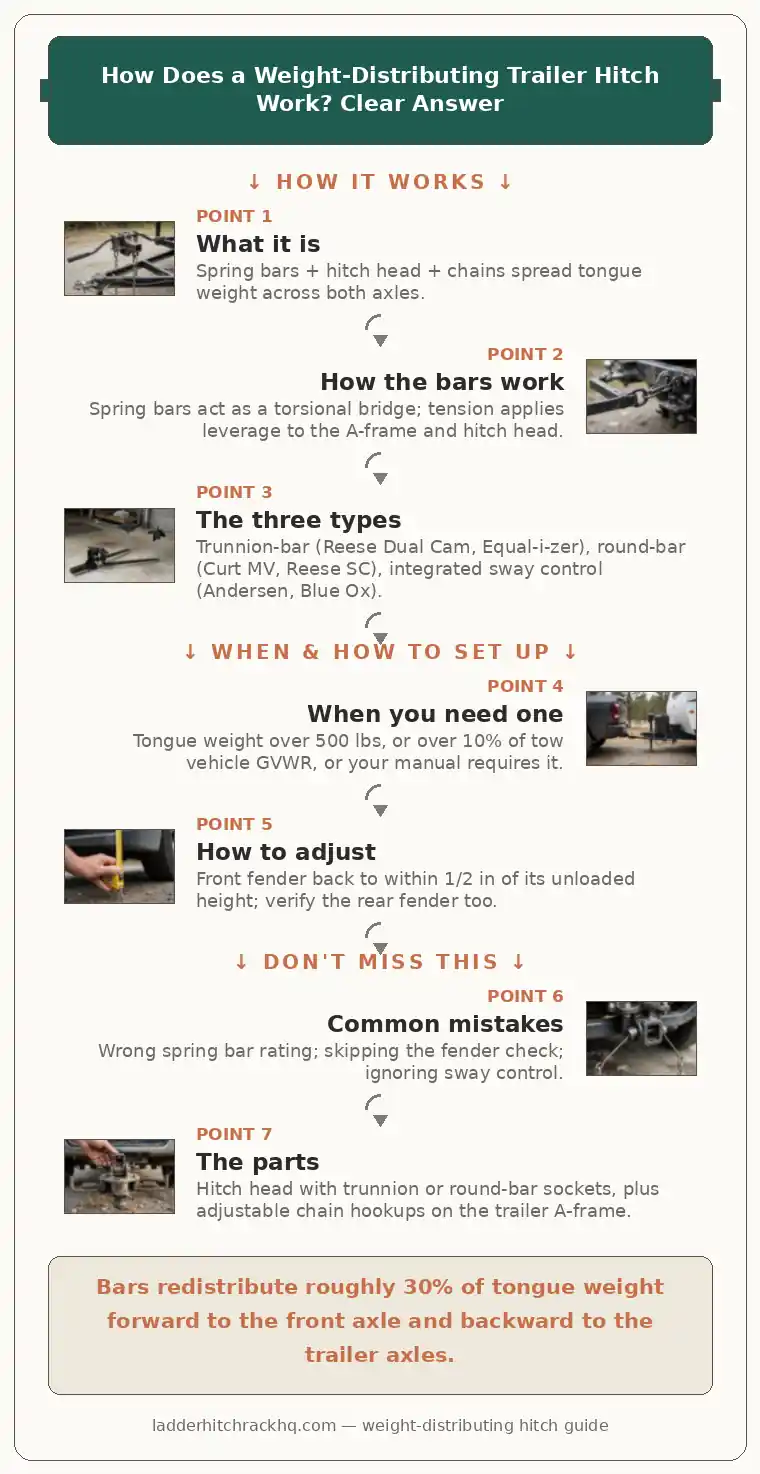
A weight distributing trailer hitch works by using two spring bars that act as a torsional bridge between the tow vehicle’s hitch receiver and the trailer A-frame. When tensioned, the bars apply leverage that redistributes roughly 30% of the trailer tongue weight forward to the tow vehicle’s front axle and backward to the trailer axles.
The result is a level rig with restored front axle weight, normal steering response, proper braking effectiveness, and correct headlight aim. Travel trailers over 5,000 lbs and any tongue weight over 500 lbs on half-ton pickups typically require weight distribution.
Choose the correct spring bar rating for your actual tongue weight, verify front fender height return to within 1/2 inch of unloaded, and add integrated sway control for trailers over 6,000 lbs. Done right, a weight distributing trailer hitch transforms a marginal tow into a safe, planted, predictable rig.