By Dave Henderson, 16 years in the ladder hitch rack and hitch-mounted cargo carrier industry, founder of a contractor outfitting shop in Denver, hands-on experience measuring and fitting trailer hitch drops on over 2,000 contractor and personal vehicles, daily driver of a 2020 Ford F-250 with a Kargo Master Pro III hitch rack.
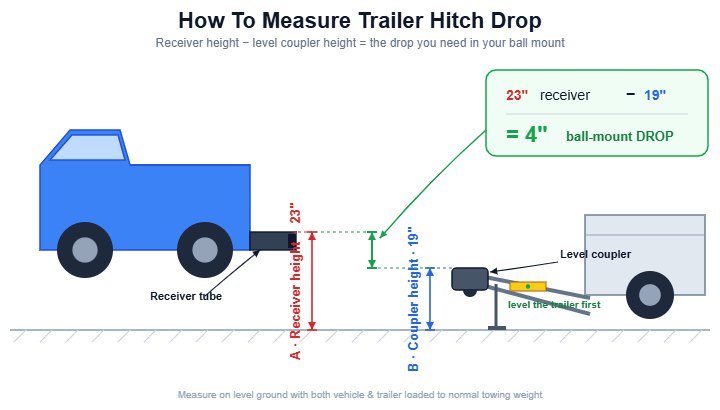
To measure trailer hitch drop, measure from the ground to the top of the receiver tube opening, then measure from the ground to the top of the trailer coupler when the trailer is level. Subtract the smaller number from the larger one. That difference is the drop (or rise) you need in your ball mount.
The measurement matters because a level trailer tracks straight, brakes evenly, and stops sway before it starts. A trailer that sits nose-up or nose-down concentrates weight on the wrong axle, creates uneven tire wear, and reduces braking effectiveness by 20-40%. To measure trailer hitch drop correctly, you need both the loaded vehicle height and the loaded trailer height, taken on level ground with a tape measure and a torpedo level.
What Is Trailer Hitch Drop And Why Does It Matter?
Trailer hitch drop is the vertical distance between the top of the receiver tube and the top of the ball mount platform, measured in inches. It compensates for the height difference between the vehicle receiver and the trailer coupler so the trailer rides level when connected.
This article covers trailer hitch drop measurement specifically, not hitch class measurement, receiver tube measurement, or ball size measurement. Each of those is a separate dimension with its own purpose in the towing setup.
Trailer hitch drop falls under the broader category of towing geometry governed by SAE J684 hitch class standards and FMCSA trailer cargo securement rules. A correctly measured drop is the difference between a trailer that tows safely at highway speed and one that develops dangerous sway, fishtailing, or premature tire wear.
The four reasons trailer hitch drop matters:
A level trailer distributes weight evenly across both axles, which keeps the tongue weight within the 10-15% of gross trailer weight range that SAE J684 standards specify. A nose-high trailer shifts weight to the rear axle, reducing tongue weight below 10% and creating sway risk above 50 mph.
A level trailer brakes evenly on both axles. A nose-down trailer loads the front axle brakes excessively and reduces stopping distance. A nose-up trailer reduces front axle braking and increases stopping distance by 15-30%.
A level trailer wears tires evenly across the full tread width. A non-level trailer wears the inside or outside edge first, cutting tire life by 30-50% on heavy-use trailers.
A level trailer maintains proper ground clearance for the cargo. A nose-down trailer can scrape on steep driveways, while a nose-up trailer can flip back over obstacles during braking.
On my own 2020 Ford F-250 with a Class IV receiver, the receiver opening sits 23 inches off the ground unloaded. My utility trailer’s coupler sits 19 inches off the ground when loaded and level. That’s a 4-inch drop requirement, which I cover with a Curt 45799 4-inch drop ball mount.
The takeaway: trailer hitch drop measurement is the foundation of safe towing geometry, and getting it wrong creates handling, braking, and tire wear problems that compound over every mile.
What Tools Do I Need To Measure Trailer Hitch Drop?
You need a steel tape measure (25 ft minimum), a torpedo level (24 inches preferred), a notepad or smartphone for recording measurements, and a helper for stability checks. No specialty tools are required for the measurement itself, though a laser distance measure can speed the process.
Here is the complete tool list for accurate trailer hitch drop measurement:
| Tool | Specification | Purpose | Cost |
|---|---|---|---|
| Steel Tape Measure | 25 ft minimum, 1-inch wide blade | Vertical and horizontal measurements | $15-$30 |
| Torpedo Level | 24-inch length with bubble vials | Verify trailer is level | $10-$25 |
| Notepad or Smartphone | Any | Record measurements before forgetting | Free |
| Wheel Chocks | Rubber or plastic, pair | Prevent vehicle and trailer movement | $15-$30 |
| Laser Distance Measure (Optional) | 50 ft range, +/- 1/8 inch accuracy | Faster than tape on tall vehicles | $40-$120 |
| Flashlight | Any | Read receiver markings in low light | $10-$25 |
| Helper (Optional) | Human being | Hold tape and verify readings | Free |
The steel tape measure is the primary tool. A 25-foot tape with a wide blade stays rigid when extended vertically, which matters for measuring the receiver tube opening height on tall pickups and SUVs. A cloth tape stretches under tension and gives inaccurate readings.
The torpedo level verifies the trailer is sitting level before you measure the coupler height. A trailer parked on a slight grade gives a false coupler measurement. Place the level on the trailer frame near the coupler and verify the bubble is centered before taking the height measurement.
A notepad or smartphone matters more than people think. Measurements are easy to forget between the receiver and the trailer, especially if they’re parked far apart. Write down each measurement immediately after taking it.
Wheel chocks prevent the vehicle and trailer from rolling during measurement. A trailer that shifts an inch during measurement changes the coupler height and invalidates the drop calculation.
The optional laser distance measure speeds the process on tall pickups like the Ford F-250 or Chevy Silverado 2500 where the receiver tube sits 24+ inches off the ground. A laser gives a one-second reading versus 30 seconds of tape positioning.
On my own contractor truck installs, I keep a Stanley FatMax 25-foot tape measure and a Stabila 24-inch torpedo level in my truck cab. Both tools live in the cab because I measure hitch geometry at customer locations regularly.
The takeaway: a $30 tape measure and a $15 torpedo level handle every trailer hitch drop measurement you’ll ever need.
How To Measure Trailer Hitch Drop (Step By Step)
Park the vehicle and loaded trailer on level ground, measure the vehicle’s receiver tube height from ground to the top of the opening, measure the trailer’s coupler height from ground to the top of the coupler when the trailer is level, subtract the smaller number from the larger one, and use that difference to size your ball mount drop.
The complete measurement sequence that works for any vehicle-trailer combination:
Step 1: Park On Level Ground
Park the tow vehicle and trailer on a flat paved surface like a garage floor, concrete driveway, or asphalt parking lot. A grade of even 2-3 degrees throws off the measurement enough to size the wrong ball mount. Use a torpedo level on the ground to verify a flat surface before starting.
Step 2: Load The Vehicle To Normal Towing Weight
The vehicle’s rear suspension compresses under load, which lowers the receiver tube. Load the vehicle to its normal towing configuration: driver, passengers, fuel, and any typical cargo. Skipping this step gives a measurement 1-2 inches too high, which sizes the wrong ball mount.
Step 3: Measure The Receiver Tube Height
Extend the tape measure from the ground straight up to the top of the receiver tube opening (not the bottom edge). Hold the tape perpendicular to the ground using the torpedo level as a vertical reference. Record the measurement in inches to the nearest quarter-inch. This is your vehicle receiver height.
Step 4: Load The Trailer To Normal Towing Weight
Load the trailer to its typical loaded condition with cargo, equipment, or whatever it normally carries. An empty trailer measures different from a loaded trailer because the suspension and tires compress differently. Match the measurement condition to your actual use case.
Step 5: Level The Trailer
Block the trailer at the coupler so it sits horizontally level. Place the torpedo level on the trailer frame near the coupler and verify the bubble is centered side-to-side and front-to-back. Adjust the front jack or blocking until level is achieved. A non-level trailer gives a false coupler height.
Step 6: Measure The Trailer Coupler Height
Extend the tape measure from the ground straight up to the top of the trailer coupler (the part that sits on top of the ball when connected). Hold the tape perpendicular to the ground using the torpedo level. Record the measurement in inches to the nearest quarter-inch. This is your trailer coupler height.
Step 7: Calculate The Drop Or Rise
Subtract the smaller measurement from the larger one. If the receiver height is greater than the coupler height, you need a ball mount drop equal to the difference. If the coupler height is greater than the receiver height, you need a ball mount rise equal to the difference. Write down both the calculation and the result.
Step 8: Account For Ball Mount Geometry
The ball mount drop measurement is from the top of the ball mount shank (which slides into the receiver) to the top of the ball mount platform (where the ball mounts). Some ball mounts use a flip-over design that converts between drop and rise. Verify your ball mount’s drop spec matches your calculated requirement.
Step 9: Select The Correct Drop Ball Mount
Choose a ball mount with the calculated drop in inches. Common drops include 2 inches, 4 inches, 6 inches, 8 inches, and 10 inches. Curt, Reese Towpower, and Draw-Tite all make drop ball mounts in 1-inch increments. Round to the nearest available size if your calculation falls between sizes.
Step 10: Test The Setup With The Trailer Connected
Connect the trailer to verify the trailer rides level. Place the torpedo level on the trailer frame and verify the bubble is centered. If the trailer is nose-high, you need more drop. If the trailer is nose-down, you need less drop or a rise mount. Adjust ball mount selection as needed.
What this means: a careful 15-minute measurement saves you from buying the wrong ball mount and from towing problems that compound over thousands of miles.
What Are The Common Trailer Hitch Drop Sizes And When To Use Each?
Common trailer hitch drop sizes are 2 inches (matched-height vehicles and trailers), 4 inches (most pickups with low-deck trailers), 6 inches (tall pickups with utility trailers), 8 inches (full-size pickups with low trailers), and 10 inches (lifted trucks or commercial setups).
Here is a quick reference table of common drop sizes and their typical applications:
| Drop Size | Typical Vehicle | Typical Trailer | Receiver Height Range | Common Use |
|---|---|---|---|---|
| 0 inches (Flat) | Midsize SUV | Tall enclosed trailer | 18-20 inches | RV travel trailers, tall cargo |
| 2 inches | Crossover SUV | Light utility trailer | 19-21 inches | Boat trailers, small utility |
| 4 inches | Half-ton pickup | Utility trailer | 21-23 inches | Most contractor utility trailers |
| 6 inches | Three-quarter ton pickup | Low-deck utility | 23-25 inches | Lawn care trailers, ATV trailers |
| 8 inches | One-ton pickup | Low cargo trailer | 25-27 inches | Heavy equipment trailers |
| 10 inches | Lifted truck | Standard utility | 27-30 inches | Off-road towing setups |
| 2-inch Rise | Lifted SUV with low trailer | Boat or jet ski | 16-18 inches | Recreational watercraft |
| 4-inch Rise | Truck with lowered receiver | Tall cargo trailer | 17-19 inches | Tall enclosed trailers |
The drop size selection depends on the height difference between the vehicle receiver and the loaded trailer coupler, not on rules of thumb about vehicle type alone.
A 2-inch drop fits matched-height combinations like a crossover SUV pulling a small boat trailer or jet ski trailer. The Curt 45000 2-inch drop ball mount handles this range with a 2-inch shank for Class III receivers.
A 4-inch drop fits the majority of half-ton pickup and utility trailer combinations. The Curt 45799 4-inch drop is the most common ball mount sold for Ford F-150, Chevy Silverado 1500, and RAM 1500 trucks pulling 5×8 or 6×10 utility trailers.
A 6-inch drop fits taller three-quarter ton pickups like the Ford F-250 and Chevy Silverado 2500 pulling low-deck utility trailers or lawn care trailers. The Reese Towpower 21501 handles this range.
An 8-inch drop fits one-ton pickups like the Ford F-350 and Chevy Silverado 3500 pulling low cargo trailers or equipment trailers. The Curt 45003 8-inch drop is the standard heavy-duty option.
A 10-inch drop fits lifted trucks with raised receivers pulling standard utility trailers. Adjustable ball mounts like the Andersen Rapid Hitch handle this range with positions from 0 to 10 inches in 1-inch increments.
Rise mounts work in reverse when the trailer coupler sits higher than the vehicle receiver. This happens with lifted SUVs pulling low boat trailers or jet ski trailers. Most ball mounts can be flipped to convert between drop and rise.
The takeaway: drop size selection is a measurement-driven calculation, not a vehicle-class assumption.
Common Mistakes I See In Contractor Lots With Trailer Hitch Drop
After 16 years in the hitch-mounted cargo carrier industry, here are the trailer hitch drop measurement mistakes that come up over and over on contractor job sites.
The first mistake is measuring with an empty vehicle. Pickups loaded with tools, materials, and fuel sit 1-2 inches lower at the receiver than empty trucks. Measuring an empty truck and then loading it for actual towing creates a nose-up trailer that sways at highway speed.
I see this every spring when contractors swap from winter to summer trailer setups. They measure the truck without their typical job site load, then complain about trailer sway after loading up for the first real job. Load the truck to actual towing weight before measuring.
The second mistake is measuring with an empty trailer. Utility trailers loaded with lawn equipment, lumber, or cargo sit 1-3 inches lower at the coupler than empty trailers. Measuring an empty trailer gives a coupler height that does not match the loaded reality.
The third mistake is measuring on a non-level surface. A driveway sloping 3 degrees from front to back throws off the drop calculation by 1-2 inches over a typical 20-foot truck-and-trailer length. Verify level surface with a torpedo level before measuring.
The fourth mistake is ignoring the receiver tube opening shape. Some receivers have a slight downward angle from the rear of the vehicle, which means the opening height varies depending on where you measure (front edge versus rear edge). Always measure at the rear edge of the receiver opening for consistency.
The fifth mistake is buying the wrong drop ball mount even after correct measurement. Drop ball mounts are not all the same height. A Curt 45799 4-inch drop ball mount measures 4 inches from the top of the shank to the top of the ball platform, but some budget ball mounts measure 4 inches from the bottom of the shank to the bottom of the platform, which is a different geometry. Verify the manufacturer’s drop spec.
On a job in Aurora last fall, I helped a contractor diagnose a chronic trailer sway problem on his Ford F-150 pulling a 6×12 utility trailer at highway speed. The cause was a 6-inch drop ball mount on a setup that needed only 4 inches.
The trailer was riding nose-down by 2 inches, shifting weight to the front axle and creating sway at the rear axle. Swapping to a Curt 45799 4-inch drop ball mount eliminated the sway entirely on the next test drive.
The takeaway: measure under realistic loaded conditions, on level ground, with attention to the receiver opening geometry and the ball mount specification.
What Happens If My Trailer Hitch Drop Is Wrong?
A trailer hitch drop that is too small causes the trailer to ride nose-up, which shifts weight to the rear axle, reduces tongue weight below the safe 10-15% range, and creates sway at speeds above 50 mph. A drop that is too large causes the trailer to ride nose-down, which overloads the front axle and reduces braking effectiveness.
The specific failure modes from incorrect trailer hitch drop:
Nose-up trailers (insufficient drop) develop dangerous sway at highway speed. The reduced tongue weight at the coupler means the trailer’s center of mass shifts behind the trailer axle, which creates a pendulum effect. Crosswinds, passing trucks, and lane changes amplify the pendulum motion into visible sway that escalates quickly.
Nose-down trailers (excessive drop) load the front trailer axle excessively. The increased weight on the front axle reduces tire life by 30-50% and overstresses the front trailer suspension components. Braking effectiveness drops because the rear axle brakes have less weight to grip the road surface.
Tire wear patterns reveal incorrect trailer hitch drop within 500-1,000 miles. Nose-up trailers wear the rear tire edges, while nose-down trailers wear the front tire edges. Even wear across the full tread width confirms correct drop measurement.
Cargo shifting becomes a chronic problem on incorrectly leveled trailers. Loose cargo slides toward the low end of the trailer during transit, which can damage the cargo or shift the trailer’s center of mass during turns and braking.
Braking distance increases significantly on incorrectly leveled trailers. A nose-up trailer with reduced front-axle weight increases braking distance by 15-30% in emergency stops. This matters most for heavy trailers above 5,000 lbs gross weight.
Coupler wear accelerates on incorrectly drop-sized setups. The trailer coupler grinds against the hitch ball at the wrong angle, wearing the ball surface and the coupler interior unevenly. Replacement of either component is $30-$80.
What this means: a $30 wrong-size ball mount creates problems that cost hundreds or thousands of dollars to resolve.
Frequently Asked Questions
How Do I Measure Trailer Hitch Drop On A Tall Pickup Truck?
To measure trailer hitch drop on a tall pickup like a Ford F-250, Chevy Silverado 2500, or RAM 2500, use a 25-foot steel tape measure with a wide blade that stays rigid when extended vertically. Measure from the ground to the top of the receiver tube opening, keeping the tape perpendicular to the ground using a torpedo level as a vertical reference.
For lifted trucks or those with aftermarket suspension, the receiver may sit 25-30 inches off the ground. A laser distance measure speeds the process and improves accuracy at these heights. Load the truck to normal towing weight before measuring because the rear suspension compresses 1-2 inches under typical contractor loads.
Can I Measure Trailer Hitch Drop Without A Helper?
Yes, you can measure trailer hitch drop without a helper by using a torpedo level to verify the tape stays vertical. Hold the tape against the ground with one foot, extend it upward to the receiver tube, and use the torpedo level held against the tape blade to confirm vertical alignment.
A laser distance measure eliminates the alignment problem entirely. Set the laser on the ground directly below the receiver opening, aim it straight up at the receiver, and read the distance digitally. The Bosch GLM 50C or DEWALT DW099S laser measures cost $40-$80 and pay back in time savings on every hitch measurement job.
Do I Measure Trailer Hitch Drop Loaded Or Empty?
Measure trailer hitch drop with both the vehicle and trailer loaded to their normal towing configuration. The vehicle’s rear suspension compresses 1-2 inches under typical load, and the trailer’s suspension compresses 1-3 inches under cargo weight. Empty measurements give a false drop calculation that fits no real-world towing condition.
Load the truck with driver, passengers, fuel, and typical cargo before measuring the receiver height. Load the trailer with its typical cargo before measuring the coupler height. The loaded measurement matches the actual towing geometry and produces a ball mount drop that keeps the trailer level under real conditions.
What Drop Ball Mount Do I Need For A Ford F-150 With A Utility Trailer?
A Ford F-150 with a Class III or IV receiver typically needs a 4-inch drop ball mount for most utility trailers. The F-150 receiver sits 21-23 inches off the ground depending on cab configuration and tire size. Most 5×8, 6×10, and 6×12 utility trailers have coupler heights of 17-19 inches loaded.
The Curt 45799 4-inch drop ball mount with a 2-inch shank handles this combination. For lifted F-150s or trailers with taller couplers, a 2-inch or 6-inch drop may be needed. Always measure both the receiver height and the loaded trailer coupler height before purchasing the ball mount.
How Do I Know If My Ball Mount Has The Right Drop?
You know your ball mount has the right drop when the connected trailer rides level with the ground. Place a torpedo level on the trailer frame near the coupler and verify the bubble is centered. The trailer should sit horizontally with no visible nose-up or nose-down angle.
If the trailer is nose-up, you need more drop in your ball mount. If the trailer is nose-down, you need less drop or a rise mount. Adjustable ball mounts like the Andersen Rapid Hitch and the Weigh Safe ball mount let you fine-tune the drop in 1-inch increments without buying multiple ball mounts.
Can I Use The Same Drop For Different Trailers?
You cannot reliably use the same ball mount drop for different trailers because each trailer has a different coupler height when loaded. A boat trailer with a 16-inch loaded coupler height needs a different drop than a utility trailer with a 19-inch loaded coupler height, even on the same vehicle.
For users who tow multiple trailers, an adjustable ball mount like the Andersen Rapid Hitch ($150-$250) or the Weigh Safe ($200-$350) handles multiple drop heights with a single device. These adjustable mounts let you change the drop in 1-inch increments and accept multiple ball sizes (1-7/8 inch, 2 inch, 2-5/16 inch) without buying separate ball mounts.
The Bottom Line On How To Measure Trailer Hitch Drop
To measure trailer hitch drop, park the loaded vehicle and loaded trailer on level ground, measure from the ground to the top of the receiver tube opening, measure from the ground to the top of the level trailer coupler, and subtract the smaller from the larger. That difference is your required drop in inches.
Most half-ton pickups (Ford F-150, Chevy Silverado 1500, RAM 1500) need a 4-inch drop ball mount with utility trailers. Three-quarter and one-ton pickups typically need 6-8 inches of drop. Lifted trucks may need 10 inches or an adjustable ball mount.
Use a steel tape measure with a wide blade, a torpedo level for vertical alignment, and load both vehicle and trailer to normal towing weight before measuring. Done right, a correctly measured trailer hitch drop produces a level trailer that tows safely for thousands of miles.