By Dave Henderson, 16 years in the ladder hitch rack and hitch-mounted cargo carrier industry, founder of a contractor outfitting shop in Denver, hands-on experience load-testing and installing hitch racks on over 2,000 contractor and personal vehicles, daily driver of a 2020 Ford F-250 with a Kargo Master Pro III hitch rack.
Last updated: May 25, 2026
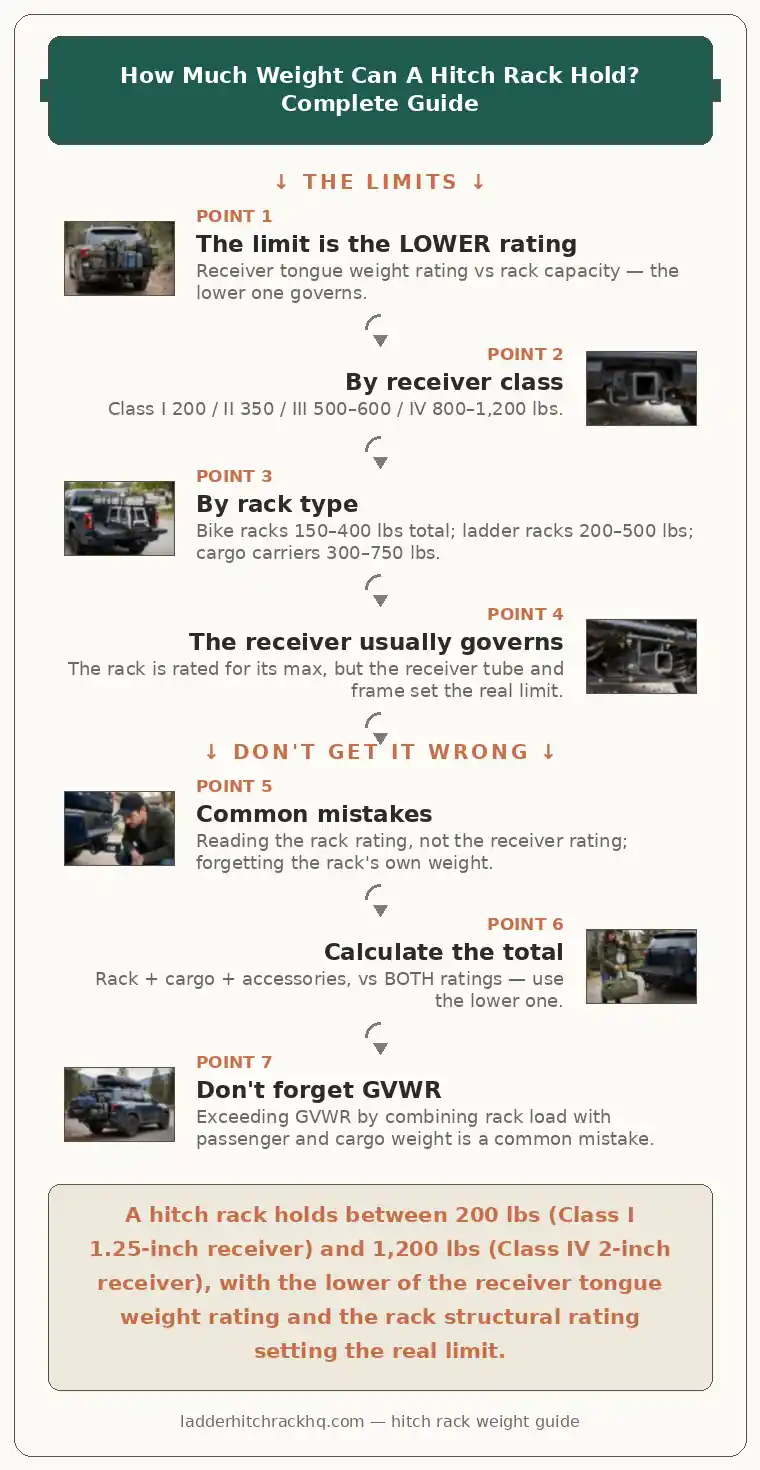
A hitch rack can hold between 200 lbs (Class I 1.25-inch receiver) and 1,200 lbs (Class IV/V 2-inch receiver), but the actual capacity is the lower of the rack’s rated weight and the receiver’s tongue weight rating. The receiver almost always sets the real ceiling.
The capacity confusion comes from manufacturers advertising the rack’s structural rating without mentioning that the receiver tongue weight rating usually caps the real-world limit. A MaxxHaul 70210 platform rack rated for 500 lbs cannot safely carry 500 lbs on a Class II receiver rated for only 350 lbs tongue weight. To know how much weight can a hitch rack hold for your setup, you need both numbers and you use the lower one.
What Determines How Much Weight A Hitch Rack Can Hold?
The weight a hitch rack can hold is determined by two ratings: the receiver tongue weight rating (the lower of the two usually governs) and the rack’s own load capacity. The receiver class (I-V), the rack’s steel gauge, the cantilever distance behind the receiver, and the type of cargo all factor into the real-world weight limit.
This article covers hitch-mounted cargo rack weight capacity specifically, not roof rack capacity, truck bed rack capacity, or trailer towing capacity. Each of those is a separate load-bearing category with different regulatory limits and engineering standards.
Hitch rack weight capacity falls under the broader category of vehicle towing and cargo regulations governed by SAE J684 hitch class standards and FMCSA 49 CFR 393.106 for cargo securement. The receiver tongue weight rating is the federally regulated limit, while the rack capacity is the manufacturer’s engineering rating.
The four factors that determine real-world hitch rack capacity:
The receiver class rating is the federally regulated limit. SAE J684 defines five classes based on tongue weight and gross trailer weight: Class I (200 lbs/2,000 lbs), Class II (350 lbs/3,500 lbs), Class III (500-600 lbs/6,000-8,000 lbs), Class IV (800-1,200 lbs/10,000-14,000 lbs), and Class V (1,200-2,700 lbs/up to 20,000 lbs).
The rack’s structural capacity is the manufacturer’s engineering rating based on the steel gauge, weld quality, and design geometry. An 11-gauge steel crossbar flexes about 40% less than a 14-gauge crossbar under a 200 lb load, which is why premium racks rate higher than budget racks even at the same physical size.
The cantilever distance behind the receiver multiplies the effective load. A rack that holds 200 lbs at 14 inches behind the receiver creates the same bending moment as a 100 lb load at 28 inches behind. This is why hanging ladder racks with 24+ inch reach often have lower rated capacities than compact platform racks.
The vehicle’s GVWR (Gross Vehicle Weight Rating) is the final limit. Loading a hitch rack at full capacity plus driver, passengers, and other cargo cannot exceed the vehicle’s GVWR or the rear axle weight rating, regardless of what the receiver and rack can physically hold.
On my own 2020 Ford F-250 with a factory Class IV 2-inch receiver (1,200 lbs tongue weight), I can run a heavy-duty hitch ladder rack with 200 lbs of ladders plus a 4-bike vertical rack carrying 4 e-bikes at 65 lbs each. Total tongue weight is around 460 lbs, well under the receiver limit and the GVWR.
The takeaway: hitch rack capacity is governed by the lower of the receiver rating and the rack rating, not by either one alone.
How Much Weight Can Each Hitch Class Hold?
Class I receivers hold up to 200 lbs tongue weight (1.25-inch opening), Class II holds 350 lbs (1.25-inch opening, heavier duty), Class III holds 500-600 lbs (2-inch opening, the standard SUV class), Class IV holds 800-1,200 lbs (2-inch opening, full-size pickups), and Class V holds 1,200-2,700 lbs (2.5-inch opening, heavy-duty commercial).
Here is a reference table of hitch class ratings and typical loads:
| Hitch Class | Receiver Opening | Tongue Weight Rating | Gross Trailer Weight | Typical Vehicles | Max Hitch Rack Load |
|---|---|---|---|---|---|
| Class I | 1.25 inch | 200 lbs | 2,000 lbs | Compact cars, subcompacts | 1-2 bike hanging rack only |
| Class II | 1.25 inch | 350 lbs | 3,500 lbs | Midsize sedans, small SUVs | 2-3 bike rack, light cargo |
| Class III | 2 inch | 500-600 lbs | 6,000-8,000 lbs | SUVs, crossovers, minivans | 4-bike platform, hitch ladder rack |
| Class IV | 2 inch | 800-1,200 lbs | 10,000-14,000 lbs | Full-size pickups, large SUVs | 6-bike vertical rack, heavy cargo |
| Class V | 2.5 inch | 1,200-2,700 lbs | up to 20,000 lbs | Heavy-duty pickups, commercial | Industrial hitch ladder rack, dual cargo |
The class breakdown matters because most riders and contractors overestimate what their hitch can carry.
Class I receivers are the lightest duty option, common on compact sedans and small crossovers. With only 200 lbs of tongue weight capacity, a Class I receiver handles a 1-2 bike hanging rack like the Allen Sports Deluxe 2-bike (18 lbs empty + two 30 lb bikes = 78 lbs total). It cannot handle a 4-bike platform rack, an e-bike rack, or a hitch ladder rack.
Class II receivers double the capacity to 350 lbs and remain 1.25-inch openings. Class II handles 2-3 bike racks, light cargo trays, and the smallest hitch ladder racks. The MaxxHaul 70210 platform bike rack (56 lbs empty) loaded with three 35 lb bikes totals 161 lbs, which fits Class II comfortably.
Class III receivers are the workhorse class for most US passenger vehicles. The 2-inch opening accepts the full range of hitch-mounted accessories: 4-bike platform racks (Kuat NV 2.0, Thule T2 Pro XTR, 1Up USA Heavy Duty), hitch ladder racks (Kargo Master Pro III, Apex BXR-ECO), and standard cargo trays. The 500-600 lbs tongue weight rating handles most real-world loads.
Class IV receivers add heavy-duty capacity for full-size pickups and large SUVs. Class IV handles 6-bike vertical racks (Yakima HangOver 4, Velocirax 4), heavy hitch ladder racks loaded with extension ladders and conduit, and e-bike racks carrying 60-80 lb bikes.
Class V receivers use a 2.5-inch opening and are found on heavy-duty pickups (Ford F-350, F-450, Chevy 3500, RAM 3500) and commercial vehicles. Class V handles industrial hitch ladder racks, dual cargo configurations, and heavy contractor loads. Adapter sleeves are required for standard 2-inch accessories.
The takeaway: match your loaded rack weight to the receiver class rating, and size up to the next class if your load is within 50 lbs of the rated capacity.
How Much Weight Can Specific Hitch Rack Types Hold?
Hitch bike racks typically hold 35-80 lbs per bike across 2-6 bikes (rack capacity 150-400 lbs total), hitch ladder racks hold 200-500 lbs of ladders and conduit, and hitch cargo carriers hold 300-750 lbs of general cargo. Specific brand ratings vary significantly within each category.
Here is a reference table of common hitch racks and their structural capacity ratings:
| Hitch Rack Type / Model | Shank Size | Rack Structural Rating | Per-Bike Or Per-Item Limit | Required Receiver Class | Real-World Load Example |
|---|---|---|---|---|---|
| Kuat NV 2.0 (Platform Bike) | 2″ | 240 lbs (4 bikes) | 60 lbs per bike | Class III | 4 mountain bikes at 35 lbs = 140 lbs |
| Thule T2 Pro XTR 2 (Platform Bike) | 2″ | 120 lbs (2 bikes) | 60 lbs per bike | Class II/III | 2 e-bikes at 55 lbs = 110 lbs |
| 1Up USA Heavy Duty Double | 2″ | 150 lbs (2 bikes) | 75 lbs per bike | Class II/III | 2 e-bikes at 65 lbs = 130 lbs |
| Yakima HangOver 4 (Vertical Bike) | 2″ | 150 lbs (4 bikes) | 37.5 lbs per bike | Class III | 4 mountain bikes at 35 lbs = 140 lbs |
| Hollywood Sport Rider SE2 (E-Bike) | 2″ | 160 lbs (2 e-bikes) | 80 lbs per bike | Class III/IV | 2 e-bikes at 65 lbs = 130 lbs |
| MaxxHaul 70210 (Platform Bike) | 2″ | 140 lbs (4 bikes) | 35 lbs per bike | Class II/III | 4 bikes at 30 lbs = 120 lbs |
| Kargo Master Pro III (Ladder Rack) | 2″ | 250 lbs at 14″ | N/A | Class III | 28-ft extension ladder (75 lbs) |
| Apex BXR-ECO (Ladder Rack) | 2″ | 200 lbs | N/A | Class III | 24-ft extension ladder (62 lbs) |
| Buyers Products LT20 (Cargo Carrier) | 2″ | 500 lbs | N/A | Class III/IV | Tools, generator, equipment |
| MaxxHaul 70423 (Ladder Rack) | 2″ | 500 lbs | N/A | Class III | Multiple ladders, lumber |
| Curt 18153 (Cargo Tray) | 2″ | 500 lbs | N/A | Class III | Coolers, luggage, gear |
The structural rating is the manufacturer’s engineering specification for the rack itself, not the receiver. A MaxxHaul 70423 ladder rack rated for 500 lbs cannot safely carry 500 lbs if mounted on a Class II receiver rated for only 350 lbs tongue weight.
The per-bike limit on bike racks matters as much as the total rating. A 4-bike rack rated for 140 lbs total but 35 lbs per bike cannot carry 4 e-bikes weighing 50 lbs each (200 lbs total exceeds rating and 50 lbs per bike exceeds per-bike limit). The per-bike limit is set by the cradle arm strength, not the total rack capacity.
The cantilever distance affects effective load. The Kargo Master Pro III ladder rack is rated for 250 lbs at 14 inches behind the receiver. The same rack at 24 inches behind the receiver effectively reduces the safe load to about 145 lbs because of the increased bending moment.
The Apex BXR-ECO is a single-ladder rack rated for 200 lbs with a 2-inch shank. It handles a 28-ft extension ladder (Werner D6228-2 at 75 lbs) plus accessories without issue. The MaxxHaul 70423 is a dual-ladder rack rated for 500 lbs but sits 6 inches lower than the Apex BXR-ECO and scrapes on steep driveways.
The takeaway: verify both the rack structural rating and the per-item or per-bike limit before loading, and reduce expectations for racks that cantilever far behind the receiver.
Why Does The Receiver Rating Usually Set The Real Limit?
The receiver tongue weight rating usually sets the real hitch rack load limit because manufacturers rate the rack itself for its maximum engineered capacity, but the vehicle’s receiver tube and frame mounting structure are engineered for a specific weight class. Exceeding the receiver rating stresses the frame welds and rear suspension.
The receiver becomes the bottleneck because of how vehicle hitches are engineered.
The receiver tube itself is sized for the class load. A Class III receiver tube is built from heavier steel (typically 5/16-inch wall thickness) than a Class II receiver (3/16-inch wall). Exceeding the rated tongue weight overstresses the tube wall at the rack-to-receiver contact point and can cause permanent deformation.
The frame mounting bolts and brackets are engineered for the class load. The factory bolt-on hitch attaches to pre-engineered frame points designed to distribute the rated load across multiple frame members. Exceeding the rating concentrates force at the mounting bolts, which can crack frame welds or strip the threaded inserts.
The vehicle’s rear suspension is designed for the rated tongue weight plus normal payload. A Class II vehicle (350 lbs tongue weight rating) loaded with 500 lbs of cargo at the hitch causes the rear suspension to compress beyond its design range. The result is sagging, reduced ride height, and accelerated wear on rear shocks and springs.
The vehicle’s braking system is calibrated for the rated payload. Adding weight beyond the receiver rating shifts the vehicle’s center of gravity rearward and reduces front-wheel braking effectiveness, increasing stopping distance and reducing emergency maneuverability.
On a job in Lakewood last spring, I watched a contractor load his 2017 Honda Pilot with a Class II 1.25-inch receiver. He installed a hitch ladder rack rated for 500 lbs and loaded 320 lbs of conduit, lumber, and ladders. The rack was within its own rating, but the Class II receiver tongue weight is only 350 lbs.
He drove 80 miles to a job site with the loaded rack. Over the trip, the receiver welds developed visible cracks where the receiver tube meets the frame mounting bracket. The fix was a $450 receiver replacement plus $200 in frame weld repairs.
The lesson: the rack rating means nothing if the receiver cannot handle the load. Always check both ratings and use the lower one.
The takeaway: receiver tongue weight rating is the federally regulated limit and usually the lower of the two ratings, making it the real-world ceiling for any hitch rack load.
What Mistakes Do People Make With Hitch Rack Weight?
The five most common hitch rack weight mistakes are reading the rack rating without checking the receiver rating, ignoring the per-bike or per-item limit, forgetting to add the rack’s own empty weight to the cargo weight, exceeding the GVWR by combining rack load with passenger and trunk cargo, and assuming all Class III receivers have the same rating.
The specific mistakes I see most often after 16 years in the industry:
Reading the rack rating without checking the receiver rating is the most common mistake. A 4-bike platform rack rated for 240 lbs (Kuat NV 2.0) seems safe for 4 e-bikes at 50 lbs each (200 lbs total). But if the receiver is a Class II rated for 350 lbs and the rack itself weighs 52 lbs, the total load on the receiver is 252 lbs (52 + 200), which is close to the limit but acceptable. If the same load went on a Class I receiver rated for 200 lbs, it would exceed the limit by 52 lbs.
Ignoring the per-bike or per-item limit destroys racks. A bike rack rated for 240 lbs total but 60 lbs per bike cannot safely carry 3 e-bikes at 80 lbs each (240 lbs total but 20 lbs over per-bike limit). The cradle arms or wheel trays bend under the higher per-item load even when total weight is within the rack rating.
Forgetting to add the rack’s empty weight is a common math error. A bike rack rated for 200 lbs cargo capacity that weighs 50 lbs empty creates 250 lbs of total tongue weight when loaded to capacity. Riders often calculate only the cargo weight and miss the rack’s own contribution to tongue weight.
Exceeding the GVWR by stacking loads is the subtlest mistake. A Class III receiver rated for 600 lbs tongue weight handles a fully loaded hitch rack at 350 lbs. But if the vehicle also has 4 passengers (700 lbs), full trunk cargo (200 lbs), and a roof box (100 lbs), the total weight may exceed the vehicle’s GVWR or rear axle weight rating.
Assuming all Class III receivers have the same rating is wrong. Class III ratings range from 500 lbs (light SUVs) to 600 lbs (full-size SUVs). Check the specific tongue weight rating stamped on your receiver tube, not the general class designation.
On my own RAM 1500 with a Class IV receiver, the tongue weight rating is 1,200 lbs but the vehicle GVWR is 6,500 lbs. With me (200 lbs), 3 passengers (550 lbs), a roof box (150 lbs), and bed cargo (400 lbs), I am at 5,500 lbs of curb-plus-cargo weight. Adding 500 lbs to the hitch puts me at 6,000 lbs, still under GVWR but with limited margin.
The takeaway: check the rack rating, the per-item limit, the rack’s empty weight, the receiver rating, and the GVWR before loading. All five matter, and the lowest one is your real limit.
How Do I Calculate The Total Weight On My Hitch Rack?
To calculate total weight on a hitch rack, add the rack’s empty weight, all loaded cargo or bike weights, plus any accessories (locks, light kits, covers). Compare the total to both the rack’s structural rating and the receiver’s tongue weight rating, using the lower of the two as your real limit.
The calculation process is straightforward but skipped by most riders.
Start with the rack’s empty weight. Manufacturer specifications list this clearly. The Kuat NV 2.0 4-bike platform rack weighs 52 lbs with the add-on, the Thule T2 Pro XTR 2 weighs 53 lbs, and the Hollywood Sport Rider SE2 e-bike rack weighs 50 lbs. Budget racks like the MaxxHaul 70210 weigh 56 lbs.
Add the per-bike or per-item weight. A typical road bike weighs 18-22 lbs, a hybrid bike weighs 28-32 lbs, a mountain bike weighs 30-40 lbs, and an e-bike weighs 50-80 lbs. Verify your specific bike weights rather than estimating.
Add accessories. A bike cable lock weighs 1-3 lbs, a rack cover weighs 4-8 lbs, and a supplemental light kit weighs 2-4 lbs. These small additions can push a marginal load over the limit.
Compare to both ratings. If the rack is rated for 240 lbs and the receiver is rated for 350 lbs, the rack rating (240 lbs) is the real limit. If the rack is rated for 500 lbs and the receiver is rated for 350 lbs, the receiver rating (350 lbs) is the real limit. Always use the lower number.
A worked example: Kuat NV 2.0 (52 lbs) plus 3 mountain bikes at 35 lbs each (105 lbs) plus 2 cable locks at 2 lbs each (4 lbs) plus a rack cover (6 lbs) totals 167 lbs. On a Class III receiver rated for 500 lbs and a rack rated for 240 lbs, the 167 lbs is well within both limits.
A second example: Hollywood Sport Rider SE2 (50 lbs) plus 2 e-bikes at 65 lbs each (130 lbs) plus locks and accessories (12 lbs) totals 192 lbs. On a Class III receiver rated for 500 lbs and a rack rated for 160 lbs, the 192 lbs exceeds the rack rating by 32 lbs. The setup is unsafe even though the receiver has plenty of headroom.
What this means: the math takes 60 seconds and prevents the rack failure that destroys $3,000 worth of bikes at highway speed.
Frequently Asked Questions
How Much Weight Can A Class III Hitch Hold?
A Class III hitch holds 500 to 600 lbs of tongue weight depending on the specific vehicle and hitch manufacturer. The 2-inch receiver opening accepts the full range of hitch-mounted accessories including 4-bike platform racks (Kuat NV 2.0, Thule T2 Pro XTR), hitch ladder racks, and standard cargo trays. Gross trailer weight rating runs 6,000 to 8,000 lbs.
The exact tongue weight rating is stamped on the side of the receiver tube. Check the label or stamped marking before loading. Some Class III receivers on lighter SUVs are rated at 500 lbs, while full-size SUVs and trucks often carry 600 lbs Class III ratings. The receiver rating caps the loaded rack weight regardless of the rack’s own structural capacity.
Can A 4-Bike Platform Rack Carry 4 E-Bikes?
No, a standard 4-bike platform rack rated for 35-40 lbs per bike cannot safely carry 4 e-bikes weighing 50-80 lbs each. The cradle arms bend, the trays warp, and the bikes shift during transit. The per-bike weight limit set by the rack’s cradle arm strength exceeds the total rack capacity calculation.
Use a dedicated e-bike rack like the Hollywood Sport Rider SE2 (80 lbs per bike, 2-bike capacity) or the Kuat NV 2.0 with the e-bike kit accessory (60 lbs per bike). For 4 e-bikes specifically, the 1Up USA Heavy Duty with multiple add-ons or the Yakima HangOver 4 with reduced per-bike loading are the limited options. Verify rack ratings before purchasing for e-bike use.
What Happens If I Overload My Hitch Rack?
Overloading your hitch rack causes one of several failure modes depending on which component fails first. The receiver tube can deform or crack at the rack-to-receiver contact point. The frame mounting bolts or brackets can strip or pull out of the frame. The rack itself can crack at the shank-to-crossbar weld joint. The bikes or cargo can shift and fall off the rack during transit.
The least dramatic outcome is permanent rack deformation that reduces capacity over time. The most dramatic is rack failure at highway speed, which destroys the cargo, damages following vehicles, and creates serious injury risk. Stay within both the receiver rating and the rack rating, using the lower of the two as your real limit.
Does The Vehicle GVWR Limit How Much My Hitch Rack Can Hold?
Yes, the vehicle’s Gross Vehicle Weight Rating (GVWR) is the absolute upper limit regardless of the receiver and rack ratings. GVWR includes the vehicle curb weight, all passengers, fluids, fuel, trunk cargo, roof cargo, and hitch rack cargo combined.
A Class IV receiver rated for 1,200 lbs of tongue weight does not unlock 1,200 lbs of cargo if the vehicle is already loaded with passengers and other cargo. Subtract the vehicle’s actual loaded weight from the GVWR to find the remaining capacity available for the hitch rack. The rear axle weight rating (RAWR) is also a limit because hitch loads concentrate on the rear axle specifically.
Are Tongue Weight Rating And Hitch Rack Capacity The Same Thing?
No, tongue weight rating and hitch rack capacity are two different specifications that must both be checked. Tongue weight rating is the maximum downward force the receiver can support at the receiver pin, set by SAE J684 hitch class standards. Hitch rack capacity is the maximum load the rack structure itself can carry, set by the manufacturer’s engineering specifications.
The lower of the two ratings is your real-world limit. A 500 lb rack on a 350 lb receiver maxes out at 350 lbs. A 200 lb rack on a 500 lb receiver maxes out at 200 lbs. Always verify both numbers before loading. The receiver rating is usually the lower of the two on standard SUV and crossover vehicles.
How Do I Know My Hitch Receiver Class And Rating?
Your hitch receiver class and rating are stamped on the side of the receiver tube as a metal label or directly into the steel. The label shows the hitch class (I through V), the tongue weight rating in lbs, and the gross trailer weight rating in lbs. Look under the rear bumper for the receiver tube and inspect both sides for the marking.
If the label is missing or unreadable, measure the receiver opening: 1.25 inches indicates Class I or II, 2 inches indicates Class III, IV, or V, and 2.5 inches indicates Class V. Check your owner’s manual or the manufacturer’s vehicle specifications for the exact tongue weight rating. Aftermarket hitches from Curt, Reese Towpower, and Draw-Tite always include the rating label.
The Bottom Line On How Much Weight Can A Hitch Rack Hold
A hitch rack holds between 200 lbs (Class I 1.25-inch receiver) and 1,200 lbs (Class IV 2-inch receiver), with the lower of the receiver tongue weight rating and the rack structural rating setting the real limit.
For most US passenger vehicles with a Class III 2-inch receiver, the practical hitch rack capacity is 500-600 lbs of tongue weight, which handles a 4-bike platform rack with e-bikes or a hitch ladder rack with extension ladders and conduit. Add the rack’s empty weight plus all cargo weights plus accessories, then compare to both ratings.
Check the receiver class stamp, verify the rack manufacturer’s rating, calculate total tongue weight, and stay within the lower number. Done right, a hitch rack carries everything you need for years of trouble-free use.