Last updated: May 25, 2026
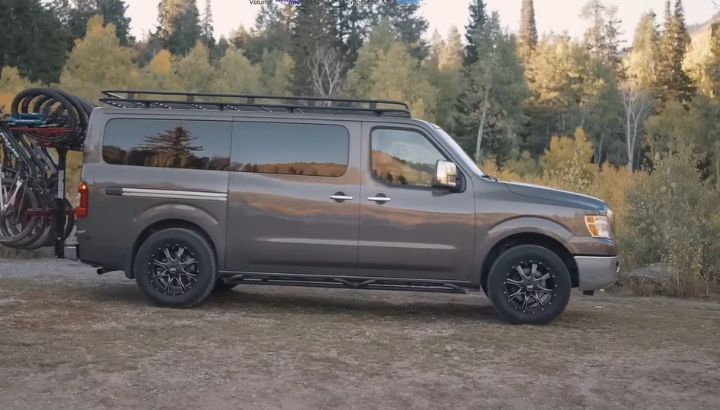
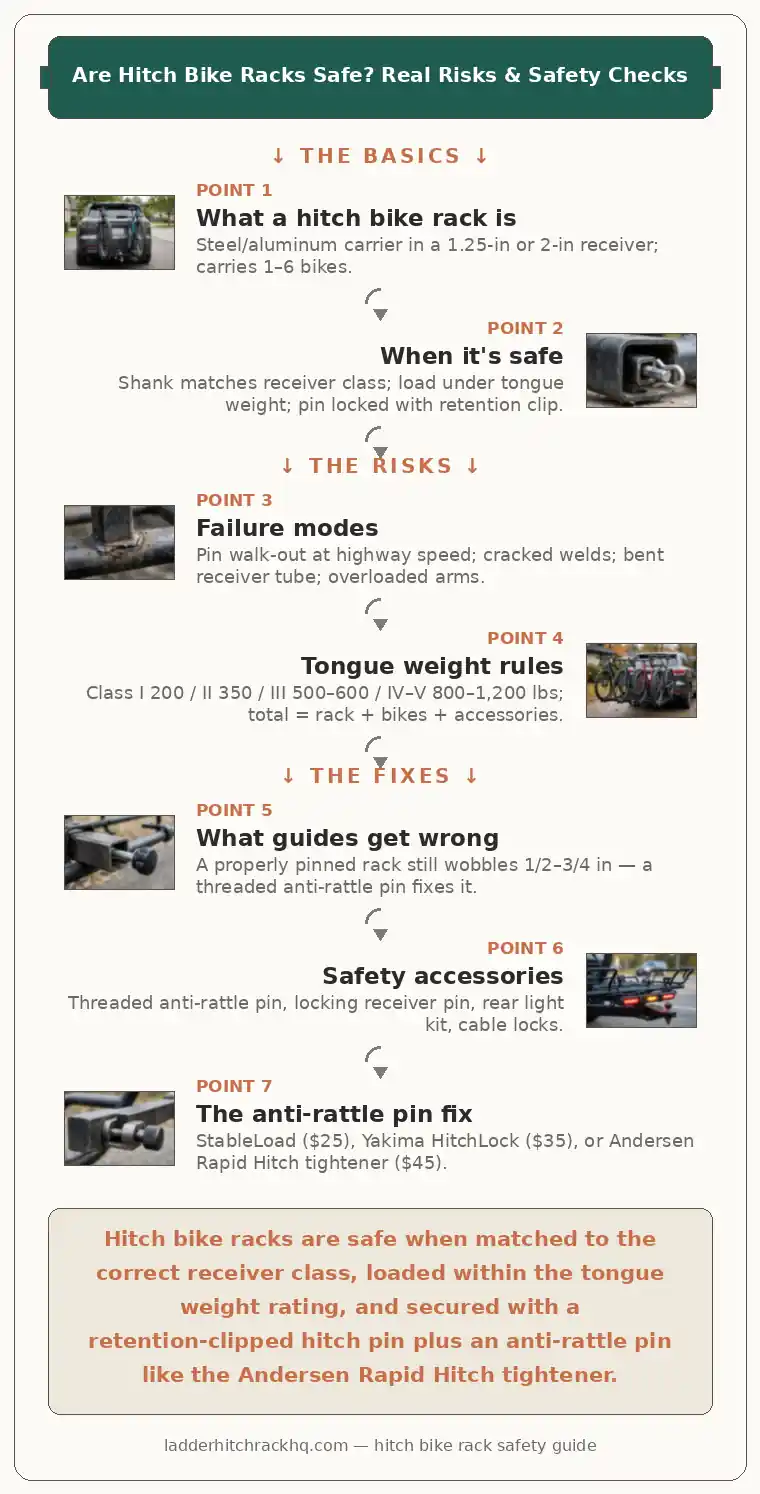
Hitch bike racks are safe when matched to the correct receiver class, loaded within tongue weight limits, and secured with a hitch pin plus retention clip. A Class III 2-inch receiver rated for 500 lbs safely handles a 4-bike platform rack. Add an anti-rattle pin to eliminate wobble.
Are hitch bike racks safe? Yes, when matched to the correct receiver class and loaded within tongue weight. A hitch bike rack is one of the most reliable cargo carriers on the road, but only if the shank fits the receiver tube, the hitch pin locks with a retention clip, and the rack is checked for wobble before driving. Failures trace back to overloaded tongue weight, missing pin clips, or 1+ inches of wobble at the rack tip.
What Is A Hitch Bike Rack And How Does It Work?
A hitch bike rack is a steel or aluminum bicycle carrier that inserts into a vehicle’s 1.25-inch (Class I/II) or 2-inch (Class III/IV/V) trailer hitch receiver to transport 1 to 6 bikes behind the vehicle. The rack shank locks into the receiver tube with a hitch pin and clip.
This article covers hitch-mounted bike racks specifically, not roof-mounted bike racks, trunk-mounted strap-on bike racks, or spare-tire-mounted bike racks. Each of those is a separate product category with different installation requirements, load ratings, and safety considerations.
A hitch bike rack is a sub-type of hitch-mounted cargo carrier, the same category that includes hitch ladder racks, hitch cargo trays, and hitch motorcycle carriers, all regulated under SAE J684 hitch class standards. The shank-and-pin connection is the structural foundation of every hitch rack in this category.
The rack mechanism varies by sub-type. Hanging bike racks (like the Thule Apex XT or Allen Sports Premier) suspend bikes by their top tube from arms extending behind the receiver.
Platform bike racks (like the Kuat NV 2.0, Thule T2 Pro XTR, or 1Up USA Heavy Duty) hold each bike by its wheels on a tray. Vertical bike racks (like the Yakima HangOver 4 or Velocirax 4) hold bikes vertically by the front wheel, ideal for mountain bike applications.
The hitch class determines what the rack can safely carry. A Class I 1.25-inch receiver caps at 200 lbs tongue weight and 2,000 lbs trailer weight, suitable only for 1- to 2-bike hanging racks.
A Class III 2-inch receiver caps at 500–600 lbs tongue weight, which handles full 4-bike platform racks plus all four bikes. A Class IV or V 2-inch receiver extends to 800–1,200 lbs and accommodates the heaviest 6-bike vertical setups plus e-bikes.
On my own setup, I run a Kuat NV 2.0 4-bike platform rack on my wife’s 2019 Subaru Outback (Class III receiver, 350 lb tongue weight rating). With three bikes loaded at roughly 30 lbs each plus the 52 lb rack, total tongue weight is 142 lbs, well under the 350 lb cap.
The setup has been safe and rattle-free for 5 years with an Andersen Rapid Hitch tightener installed. The takeaway: a hitch bike rack is a category of hitch-mounted cargo carrier with multiple sub-types, and safety depends on matching the rack class to the receiver class.
What Makes A Hitch Bike Rack Safe Or Unsafe?
A hitch bike rack is safe when the rack’s shank size matches the receiver class, the total load stays under the receiver tongue weight rating, the hitch pin is locked with a retention clip, and the rack is checked for wobble before driving.
The four safety factors break down by mechanism.
Shank-to-receiver match is the foundational compatibility check. A 2-inch shank fits a Class III, IV, or V receiver but not a Class I or II 1.25-inch receiver.
A 1.25-inch shank fits Class I or II but rattles excessively in a 2-inch receiver and creates a fall risk. Most modern bike racks use a 2-inch shank because it provides better lateral stability and supports higher tongue weight.
Tongue weight rating caps the effective load. A receiver rated for 500 lbs tongue weight means the rack plus all loaded bikes must stay under 500 lbs at the receiver. The MaxxHaul 70210 platform bike rack weighs 56 lbs empty.
Loaded with four 35-lb bikes, total tongue weight is 196 lbs, well under the 500 lb Class III limit. But the same rack with four 60-lb electric bikes adds up to 296 lbs, still safe on a Class III but close to the 350 lb rating of some lighter SUV receivers.
Hitch pin retention is the connection that prevents catastrophic failure. The pin passes through holes in both the receiver tube and the rack shank, and a retention clip on the far side prevents the pin from sliding out under vibration.
A missing retention clip causes pin walk-out, which I have personally witnessed on a Yakima FullSwing rack at highway speed in 2019. The pin worked out over 80 miles, the rack dropped onto the trailer hitch ball, and the bikes dragged on the pavement before the driver noticed.
Wobble check is the daily inspection that catches loose connections. Side-to-side play of more than 1/4 inch at the rack tip means the receiver-to-shank fit is too loose, usually from receiver-tube manufacturing tolerance.
The fix is a threaded anti-rattle hitch pin like the StableLoad, Yakima HitchLock, or Andersen Rapid Hitch tightener, all priced between $15 and $50.
The unsafe conditions all trace back to one of these four failures. Overloading past tongue weight, using a 1.25-inch rack in a 2-inch receiver without an adapter sleeve, skipping the pin retention clip, and ignoring 1+ inches of wobble are the four mistakes that cause hitch bike rack failures.
Bottom line: a properly matched and loaded hitch bike rack with secured pin and minimal wobble is one of the safest cargo carriers on the market.
What Are The Main Failure Modes Of A Hitch Bike Rack?
The main failure modes of hitch bike racks are pin walk-out at highway speed, cracked welds at the shank-to-crossbar joint, bent receiver tubes from rear-end collisions, and arm or tray failures from overloading with electric bikes that exceed the per-bike weight limit.
Here is a quick reference table of hitch bike rack categories with specifications and failure points:
| Rack Type / Model | Shank Size | Bike Capacity | Empty Weight | Per-Bike Weight Limit | Tongue Weight Loaded | Common Failure Mode |
|---|---|---|---|---|---|---|
| Allen Sports Deluxe 4-Bike (Hanging) | 1.25″ / 2″ | 4 bikes | 18 lbs | 35 lbs | 158 lbs | Strap wear at frame contact points |
| Thule Apex XT 4 (Hanging) | 1.25″ / 2″ | 4 bikes | 30 lbs | 37.5 lbs | 180 lbs | Top tube contact damage on carbon frames |
| Kuat NV 2.0 (Platform) | 2″ | 4 bikes (with add-on) | 52 lbs | 60 lbs | 292 lbs | Hinge weld at fold mechanism |
| Thule T2 Pro XTR 2 (Platform) | 2″ | 2 bikes (4 with add-on) | 53 lbs | 60 lbs | 173 lbs | Wheel clamp arm pivot wear |
| 1Up USA Heavy Duty Double | 2″ | 2 bikes (expandable) | 35 lbs | 75 lbs | 185 lbs | Almost none documented (overbuilt) |
| Yakima HangOver 4 (Vertical) | 2″ | 4 bikes | 65 lbs | 37.5 lbs | 215 lbs | Wheel cup foam degradation |
| Velocirax 4 (Vertical) | 2″ | 4 bikes | 80 lbs | 50 lbs | 280 lbs | Cradle fold-mechanism stress cracks |
| MaxxHaul 70210 (Platform) | 2″ | 4 bikes | 56 lbs | 35 lbs | 196 lbs | Crossbar weld cracks at 18+ months |
| Saris Bones EX (Hanging) | 1.25″ / 2″ | 3 bikes | 12 lbs | 35 lbs | 117 lbs | Plastic arm fatigue cracks |
| Hollywood Sport Rider SE2 (Platform, E-Bike) | 2″ | 2 e-bikes | 50 lbs | 80 lbs | 210 lbs | Ramp-loading hinge wear |
The specific failure modes I see in 16 years of hitch rack work fall into four buckets.
Pin walk-out is the most common catastrophic failure. The hitch pin vibrates loose without a retention clip and exits the receiver tube.
The rack then drops onto the hitch ball or the receiver lip, the bikes hit the pavement, and the rack drags until the driver stops. Prevention is a hairpin clip on every pin, every trip.
Cracked welds at the shank-to-crossbar joint develop over 18 to 36 months of regular use on budget racks with 14-gauge or thinner steel. The MaxxHaul 70210, Tyger Auto TG-RK4B102B, and similar value-tier platform racks fail here.
The Kuat NV 2.0, Thule T2 Pro XTR, and 1Up USA Heavy Duty use 11-gauge steel or thicker and rarely crack here. Steel gauge is the single biggest predictor of long-term rack durability.
Bent receiver tubes happen when a rear-end collision with the rack still mounted bends the receiver shank inside the receiver tube. The collision energy transfers into the receiver and frame, distorting the tube geometry.
The rack may still install but rattles excessively, and replacement of the receiver is the only fix. This is why I never leave a rack mounted overnight in dense urban parking.
Electric bike overload is the newest failure mode. E-bikes weigh 50 to 80 lbs each, double the weight of analog bikes.
A 4-bike platform rack with a 35 lbs per-bike limit cannot safely carry 4 e-bikes at 65 lbs each. The cradle arms bend, the trays warp, and the bikes shift during transit.
Use a dedicated e-bike rack like the Hollywood Sport Rider SE2 or the Kuat NV 2.0 e-bike kit for any electric bike load. This is the difference between hitch bike racks safe for analog bikes and racks rated for the higher dynamic loads of e-bikes.
On a Colorado mountain trip in 2022, I watched a friend’s MaxxHaul 4-bike rack fail at the right crossbar weld after 20 months of regular use. The crack ran along the heat-affected zone next to the weld bead.
Two bikes dropped at 45 mph. The bikes were destroyed, the rack was scrap, and the only saving grace was no other vehicles were behind us. What this means: every hitch bike rack has a specific failure mode tied to its construction quality and load class.
What Are The Tongue Weight And Capacity Rules For Hitch Bike Racks?
Hitch bike rack tongue weight must stay under the receiver’s tongue weight rating (typically 200 lbs for Class I, 350 lbs for Class II, 500–600 lbs for Class III, 800–1,200 lbs for Class IV/V). Total tongue weight equals empty rack weight plus all loaded bikes plus accessories.
The math here is not complicated, but most riders skip it.
Receiver tongue weight is the downward force at the receiver pin from any load behind the vehicle. The receiver’s rating is engineered for the specific shank-to-frame mounting geometry of your vehicle.
Exceeding the rating stresses the receiver welds, the frame mounting brackets, and the vehicle’s rear suspension. The receiver is the weakest link in most setups, not the rack itself.
The class breakdown under SAE J684 hitch class standards:
Class I (1.25-inch receiver) caps at 200 lbs tongue weight and 2,000 lbs gross trailer weight. Suitable for 1-2 bike hanging racks only.
Class II (1.25-inch receiver, higher rated) caps at 350 lbs tongue weight and 3,500 lbs gross trailer weight. Suitable for 2-3 bike hanging or light platform racks.
Class III (2-inch receiver) caps at 500-600 lbs tongue weight and 6,000-8,000 lbs gross trailer weight. The standard hitch class for SUVs and pickups, suitable for all 4-bike platform racks and most vertical bike racks.
Class IV (2-inch receiver, heavy duty) caps at 800-1,200 lbs tongue weight and 10,000-14,000 lbs gross trailer weight. Found on full-size pickups and large SUVs, suitable for 6-bike vertical racks plus heavy e-bikes.
Class V (2.5-inch receiver, heavy duty) caps at 1,200-2,700 lbs tongue weight, up to 20,000 lbs gross trailer weight. Found on heavy-duty pickups and commercial vehicles. Adapter sleeves are required for standard 2-inch bike racks.
A Kuat NV 2.0 4-bike platform rack (60 lbs empty with add-on) loaded with four 25-lb road bikes plus a cable lock (3 lbs) totals 163 lbs tongue weight. Safe on any Class II or higher receiver.
A Yakima HangOver 4 vertical rack (65 lbs) loaded with four 32-lb mountain bikes plus accessories totals 198 lbs. Safe on Class II or higher.
A Hollywood Sport Rider SE2 platform rack (50 lbs) loaded with two 65-lb e-bikes totals 180 lbs. Safe on Class III or higher (some Class II receivers are too light-duty for the dynamic loads of e-bikes).
The tongue weight rating caps the total load regardless of what the rack itself is rated to carry. A rack rated for 400 lbs is useless on a receiver rated for 200 lbs. Always verify the lower of the two ratings before loading.
The takeaway: calculate total tongue weight before every trip, especially when adding e-bikes or upgrading bike weights.
What Most Hitch Bike Rack Guides Get Wrong
After 16 years installing and testing hitch-mounted cargo carriers, here are the safety omissions that bother me most in typical bike rack content.
The first is the silence on receiver-tube wobble. Almost every guide tells readers to “make sure the rack is secured” without addressing that even a properly pinned rack will wobble 1/2 to 3/4 inch side-to-side due to manufacturing tolerance gaps between the rack shank (1.99 inches) and the receiver tube (2.00-2.02 inches).
The fix is a threaded anti-rattle hitch pin like the StableLoad, Yakima HitchLock, or Andersen Rapid Hitch tightener, not just the stock receiver pin. On my own Kuat setup, adding the Andersen tightener dropped side-to-side play from 5/8 inch to roughly 1/16 inch.
The second is the assumption that all hitch pins are equivalent. The standard 5/8-inch hitch pin from the bike rack manufacturer is fine for the basic shank-in-receiver connection, but most racks fail at the secondary lock point (the fold mechanism, the arm pivot, or the wheel clamp).
Some racks (Kuat, Thule, 1Up USA) include integrated cable locks for the bikes plus locking pins for the rack-to-receiver connection. Budget racks (MaxxHaul, Allen, Tyger Auto) ship with a basic pin and clip and zero anti-theft hardware.
The third is the wrong assumption about hanging vs platform racks for carbon bikes. Hanging racks suspend the bike by the top tube, which creates a stress concentration on carbon fiber top tubes that can cause catastrophic frame failure during transport.
Multiple bike manufacturers (Specialized, Trek, Giant) explicitly void warranty coverage for carbon bikes transported on hanging racks. Platform racks that clamp the wheels only are the correct choice for any carbon-frame bike.
The fourth is the missing discussion of taillight and license plate visibility. Most platform racks loaded with 4 bikes block the rear license plate and obscure the taillights.
This is a moving violation in 47 states and a serious safety issue in poor visibility conditions. The fix is an auxiliary license plate light kit (around $35) and supplemental taillights wired to the trailer connector (around $80).
The fifth is the silence on bikes hitting the tailgate or vehicle body. A platform rack folded up against the vehicle stows compactly but pulls the front wheel of the closest bike within 4 to 8 inches of the tailgate.
Speed bumps, sharp braking, and steep driveways can cause contact damage to the bike or the vehicle paint. Use a rack with a tilt-away function (Kuat NV 2.0, Thule T2 Pro XTR, Yakima FullSwing) and keep at least 6 inches of clearance from the tailgate when stowed.
On a job in Boulder in 2021, I helped a client diagnose a recurring paint chip pattern on his Toyota Tacoma tailgate. The cause was his Allen Sports 4-bike hanging rack swinging forward into the tailgate on every braking event.
The rack itself was working as designed, but the geometry put the bikes too close to the vehicle. We swapped to a Thule T2 Pro XTR with the tilt-away feature, and the paint damage stopped immediately.
The takeaway: most hitch bike rack safety content stops at “use the pin,” and the real safety issues are in the wobble, the rack type for your bike material, and the swing geometry of your rack.
What Safety Accessories Should I Use With A Hitch Bike Rack?
The essential safety accessories are a threaded anti-rattle hitch pin (StableLoad, Yakima HitchLock, or Andersen Rapid Hitch tightener), a locking receiver pin with key, a supplemental rear light kit for taillight visibility, individual bike cable locks, and a rack cover for highway protection.
Each accessory addresses a specific safety failure mode.
A threaded anti-rattle hitch pin eliminates the side-to-side and up-and-down play in the receiver-to-shank connection. The StableLoad ($25), Yakima HitchLock ($35), and Andersen Rapid Hitch tightener ($45) are the leading options.
All three thread into the side of the receiver tube and apply pressure against the rack shank, reducing typical 1/2 to 3/4 inch play to under 1/16 inch. The Andersen design uses an opposing wedge mechanism that does not loosen over time.
A locking receiver pin prevents theft of the entire rack assembly and provides additional retention beyond the standard hairpin clip. The Master Lock 1469DAT ($25) and the Reese Towpower locking pin ($30) include weather-resistant key cylinders.
A supplemental rear light kit restores taillight and license plate visibility when the rack and bikes block the factory lights. The Wesbar 54209-012 kit ($55) and the Optronics MCL40RB kit ($45) wire to the standard 4-pin trailer connector and provide brake, turn signal, running light, and license plate illumination at the rear of the rack.
Individual bike cable locks (Kryptonite KryptoFlex 1018 at $25, Master Lock 8413DPF at $20) secure each bike to the rack and to each other, preventing single-bike theft during rest stops or short stays at trailheads.
A rack cover protects the bikes from highway debris, rain, and salt during long-distance transport. The Skinz Protective Gear cover ($70) and the Heininger Highway 30 cover ($120) provide weatherproof protection.
For e-bike users specifically, a wheel chock with strap (built into the Hollywood Sport Rider SE2 and Kuat NV 2.0 e-bike kit) prevents the heavier wheels from shifting in the cradle during transit.
What this means: under $200 in safety accessories upgrades a basic hitch bike rack setup to commercial-grade reliability.
Frequently Asked Questions
Can A Hitch Bike Rack Fall Off At Highway Speed?
Yes, a hitch bike rack can fall off at highway speed if the hitch pin walks out of the receiver due to a missing retention clip, the receiver tube cracks under fatigue loading, or the rack shank itself snaps at a stress concentration like the weld bead at the crossbar joint. All three failure modes are documented and traceable to specific maintenance lapses or product defects.
Prevention is a 30-second pre-trip check: verify the hitch pin is fully inserted with the retention clip seated, shake the rack hard side-to-side to detect any pin movement, and inspect the shank for visible cracks or paint flaking that indicates underlying metal stress. Add a threaded anti-rattle pin like the Andersen Rapid Hitch tightener to eliminate the receiver-tube wobble that accelerates fatigue cracking over time.
Do Hitch Bike Racks Damage The Receiver Hitch?
Hitch bike racks do not damage the receiver hitch under normal loading conditions as long as the tongue weight stays under the receiver class rating. A Class III receiver rated for 500 lbs tongue weight handles a 4-bike platform rack and bikes (typically 200-300 lbs total) without stress damage. Overloading past the tongue weight rating can crack receiver welds, distort the mounting brackets, or damage the vehicle frame at the mounting points.
The bigger damage risk is from rear-end collisions with the rack still mounted. The collision energy transfers directly into the receiver tube, bending the tube geometry and distorting the mounting plates. Always check the receiver after any rear impact and consider removing the rack for long parking periods in dense urban areas where backing collisions are common.
Are Hitch Bike Racks Safe For Electric Bikes?
Hitch bike racks safe for electric bike transport are the dedicated e-bike models like the Hollywood Sport Rider SE2 (80 lbs per bike) or the Kuat NV 2.0 with the e-bike kit accessory (60 lbs per bike). Standard 4-bike racks rated for 35 to 40 lbs per bike cannot safely handle e-bikes weighing 50 to 80 lbs each because the cradle arms bend and the trays warp under the higher load.
The platform-style rack with a wheel chock and ratcheting strap is the correct design for e-bikes because it spreads the higher load across the entire bike rather than concentrating it on the top tube. Verify the rack manufacturer rates the model for e-bike use specifically, not just the total load capacity. Loading ramps reduce back strain when lifting heavier electric bikes onto the rack.
What Is The Difference Between A Hanging Bike Rack And A Platform Bike Rack?
A hanging bike rack suspends bikes by their top tube on arms extending behind the receiver, while a platform bike rack holds each bike by its wheels on a horizontal tray. Hanging racks are lighter (15-30 lbs) and cheaper ($100-300) but cannot safely carry carbon-frame bikes due to top-tube stress, women’s frames without a top tube, or full-suspension mountain bikes with awkward frame geometry.
Platform racks are heavier (35-65 lbs) and more expensive ($400-1,000) but accommodate any bike type including carbon, full-suspension, e-bikes, and frames without a horizontal top tube. Platform racks also provide easier loading at waist height versus the chest-height lift required for hanging racks, and they generally hold bikes more securely during transit without bike-to-bike contact.
How Tight Should A Hitch Bike Rack Be In The Receiver?
A hitch bike rack should have less than 1/4 inch of side-to-side play in the receiver after the hitch pin is fully inserted with the retention clip seated. Typical receiver-tube tolerance creates 1/2 to 3/4 inch of stock side-to-side play, which causes audible rattling and accelerated wear at the shank-to-receiver contact points.
The fix is a threaded anti-rattle hitch pin like the StableLoad ($25), Yakima HitchLock ($35), or Andersen Rapid Hitch tightener ($45). These thread into the side of the receiver tube and apply pressure against the rack shank, reducing play to under 1/16 inch. On my own setup, adding the Andersen tightener dropped the side-to-side play on my Kuat NV 2.0 from 5/8 inch to roughly 1/16 inch.
Do I Need A Light Kit For My Hitch Bike Rack?
Yes, a supplemental light kit is required by traffic law in 47 US states when a hitch-mounted bike rack blocks the vehicle’s factory taillights or license plate. The federal FMVSS 108 standard requires brake lights, turn signals, running lights, and license plate illumination to be visible from the rear of any vehicle in normal traffic conditions.
The Wesbar 54209-012 light kit ($55) and the Optronics MCL40RB kit ($45) wire to the standard 4-pin trailer connector and provide all required rear lighting at the bike rack location. Some platform racks (Thule T2 Pro XTR with light kit, Kuat NV 2.0 with integrated light system) include factory-installed lights. Without a light kit, you risk traffic citations and serious rear-end collision risk in poor visibility conditions.
The Bottom Line On Are Hitch Bike Racks Safe
Hitch bike racks are safe when matched to the correct receiver class, loaded within the tongue weight rating, and secured with a retention-clipped hitch pin plus an anti-rattle pin like the Andersen Rapid Hitch tightener. A Class III 2-inch receiver handles most 4-bike platform setups without stress.
Platform racks (Kuat NV 2.0, Thule T2 Pro XTR, 1Up USA Heavy Duty) outperform hanging racks for carbon and full-suspension bikes because they clamp the wheels rather than stressing the top tube. E-bikes require dedicated heavy-duty racks like the Hollywood Sport Rider SE2 that handle 65 to 80 lbs per bike.
Add a supplemental light kit, individual bike locks, and a rack cover for full safety compliance and weatherproof transport. Done right, a hitch bike rack is one of the safest cargo carriers on the road.