By Dave Henderson, 16 years in the ladder hitch rack and hitch-mounted cargo carrier industry, founder of a contractor outfitting shop in Denver, hands-on experience installing trailer hitches and bike racks on over 2,000 contractor and personal vehicles, daily driver of a 2020 Ford F-250 with a Kargo Master Pro III hitch rack.
Last updated: May 25, 2026
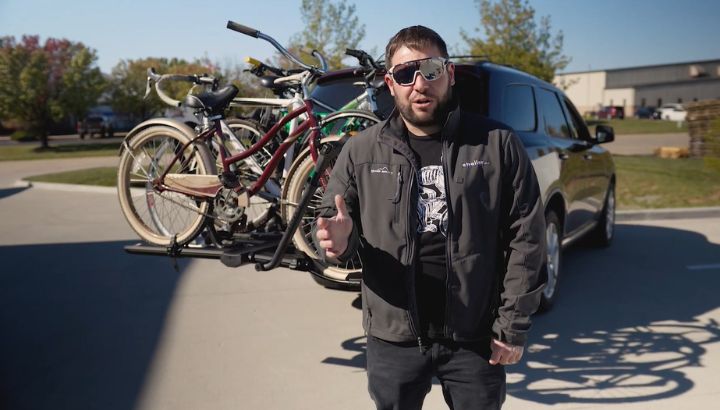
No, you do not need a trailer hitch for a bike rack if you choose a roof-mounted, trunk-mounted strap-on, or spare-tire-mounted rack. You only need a trailer hitch for hitch-mounted bike racks, which require a 1.25-inch or 2-inch receiver.
Hitch-mounted bike racks are the most secure and easiest to load, but they cost the most up front because they require a trailer hitch receiver if your vehicle does not already have one. Installing a Class III 2-inch receiver on a typical SUV runs $300 to $600 including parts and labor. Trunk and roof racks skip the hitch requirement entirely but bring their own trade-offs in security, load capacity, and ease of use.
What Is A Trailer Hitch And How Does It Work With A Bike Rack?
A trailer hitch is a receiver tube welded or bolted to the rear frame of a vehicle that accepts a 1.25-inch or 2-inch shank from trailers, bike racks, ladder racks, cargo trays, and other hitch-mounted accessories. The receiver tube provides the structural mounting point that a hitch-mounted bike rack inserts into and locks to with a hitch pin.
This article covers the question of whether a trailer hitch is required for any type of bike rack, not just hitch-mounted models. The answer depends entirely on which bike rack category you choose to use.
A trailer hitch falls under the broader category of vehicle towing equipment regulated under SAE J684 hitch class standards. The class rating (I through V) determines what tongue weight and trailer weight the hitch can safely carry. Hitch-mounted bike racks require a hitch receiver, while roof, trunk, and spare-tire racks do not.
The hitch class determines bike rack compatibility. A Class I 1.25-inch receiver caps at 200 lbs tongue weight and supports 1-2 bike hanging racks only.
A Class II 1.25-inch receiver caps at 350 lbs tongue weight and supports 2-3 bike hanging or light platform racks. A Class III 2-inch receiver caps at 500-600 lbs and supports any 4-bike platform rack. A Class IV or V 2-inch receiver caps at 800-1,200 lbs and handles 6-bike vertical racks plus e-bikes.
If your vehicle came from the factory with a trailer hitch, you can use a hitch-mounted bike rack immediately. Pickups, full-size SUVs, and most crossover SUVs ship with a Class III or IV receiver as standard equipment.
If your vehicle did not come with a hitch, you have two choices: install a hitch (one-time cost of $300-$600) and use a hitch-mounted rack, or choose a non-hitch rack type that does not require a receiver. Compact sedans, hatchbacks, and small crossovers often lack a factory hitch, making the second option more common.
On my own setup, I run a Kuat NV 2.0 hitch-mounted bike rack on my wife’s 2019 Subaru Outback (factory Class III receiver, 350 lb tongue weight rating). The factory hitch made the bike rack a plug-and-play install with no aftermarket installation cost.
The takeaway: a trailer hitch is required for hitch-mounted bike racks only, and your vehicle may already have one from the factory.
What Types Of Bike Racks Do Not Need A Trailer Hitch?
Roof-mounted bike racks, trunk-mounted strap-on bike racks, and spare-tire-mounted bike racks do not need a trailer hitch. These three categories attach to the vehicle’s roof bars, trunk lid and rear hatch, or spare tire carrier respectively, bypassing the hitch receiver entirely.
Here is a quick reference table of bike rack categories with their mounting requirements:
| Bike Rack Type | Trailer Hitch Required? | Mounts To | Typical Capacity | Price Range | Best For |
|---|---|---|---|---|---|
| Hitch-Mounted Platform (Kuat NV 2.0, Thule T2 Pro XTR) | Yes (Class III/IV, 2-inch) | Receiver tube | 4 bikes | $400-$1,000 | Daily use, heavy bikes, e-bikes |
| Hitch-Mounted Hanging (Allen Sports, Thule Apex XT) | Yes (Class I/II/III) | Receiver tube | 4 bikes | $100-$300 | Budget setups, occasional use |
| Hitch-Mounted Vertical (Yakima HangOver 4, Velocirax 4) | Yes (Class III/IV) | Receiver tube | 4-6 bikes | $700-$1,300 | Mountain bikes, shuttle trips |
| Roof-Mounted (Thule UpRide, Yakima HighRoad, Kuat Trio) | No | Crossbars on roof rails | 1 bike per mount | $150-$400 per bike | Vehicles with factory rails, no hitch |
| Trunk-Mounted Strap-On (Saris Bones EX, Allen Sports Deluxe) | No | Trunk lid, bumper, hatch | 2-3 bikes | $80-$250 | Sedans, hatchbacks, rentals |
| Spare-Tire-Mounted (Yakima SpareRide, Hollywood SR2) | No | Rear spare tire carrier | 2 bikes | $200-$400 | Jeep Wrangler, SUVs with rear spare |
| Truck-Bed Mounted (Yakima BedRock, Inno Velo Gripper) | No | Pickup bed rails or floor | 2-6 bikes | $100-$500 | Pickup trucks only |
The three non-hitch options break down by mechanism.
Roof-mounted bike racks clamp to factory roof rails or aftermarket crossbars and hold each bike vertically by the wheels or by the fork. The Thule UpRide, Yakima HighRoad, and Kuat Trio are the leading models.
Roof racks are the only solution for vehicles without a hitch that need to carry more than 2-3 bikes. The downsides are loading height (lifting a 30 lb bike above your head), reduced fuel economy (3-5 mpg loss from aerodynamic drag), and overhead clearance issues with garages and drive-thrus.
Trunk-mounted strap-on bike racks attach to the trunk lid, rear bumper, and hatch using padded contact points and adjustable straps. The Saris Bones EX, Allen Sports Deluxe, and Thule OutWay are the popular models.
Trunk racks are the cheapest entry point for occasional bike transport, typically $80 to $250 for a 2-3 bike model. The downsides are limited bike capacity, slow setup time (5-10 minutes per use), and the risk of strap loosening over long trips. Many car manufacturers also void rear-end warranty coverage for damage caused by trunk rack contact.
Spare-tire-mounted bike racks bolt to the spare tire carrier on Jeep Wranglers, certain SUVs, and vehicles with a rear-mounted spare. The Yakima SpareRide and Hollywood SR2 are the leading options.
These racks are stable, secure, and easy to load at waist height, but they only work on vehicles with the specific rear spare configuration. The spare tire carrier must be rated for the additional weight, which most factory carriers are.
The takeaway: three viable bike rack categories work without a trailer hitch, each with its own trade-offs in capacity, ease of use, and vehicle compatibility.
Why Do Most Cyclists Choose Hitch-Mounted Bike Racks?
Most cyclists choose hitch-mounted bike racks because they load at waist height, secure bikes more rigidly than roof or trunk racks, accommodate heavier e-bikes, and preserve overhead clearance for garages and drive-thrus. The trade-off is the upfront cost of a trailer hitch if the vehicle does not have one.
Hitch-mounted racks dominate the bike rack market for four main reasons.
Loading height matters more than people realize. A hitch-mounted platform rack sits 18-24 inches off the ground, which means lifting a 30 lb bike onto the rack requires only a modest knee-bend.
A roof rack sits 6-7 feet off the ground on most SUVs, requiring a full overhead lift. For an e-bike weighing 60-80 lbs, the overhead lift is genuinely dangerous and frequently impossible for one person. Hitch racks solve this entirely.
Bike security beats every other rack type. Hitch-mounted platform racks clamp the bike by the front wheel and frame, holding it rigid against bumps, sharp braking, and side winds.
Trunk-mounted strap racks rely on friction at the contact points, which loosens over long highway drives. Roof racks clamp the wheels but leave the bike exposed to crosswinds that can rip a $5,000 carbon bike off the roof at highway speed.
E-bike compatibility is a hitch-only feature for most riders. Standard e-bikes weigh 50 to 80 lbs each, which is well above the per-bike rating of trunk racks (typically 35 lbs) and many roof racks (typically 45-50 lbs).
Hitch-mounted platform racks rated specifically for e-bikes like the Hollywood Sport Rider SE2 (80 lbs per bike) and the Kuat NV 2.0 e-bike kit (60 lbs per bike) handle the heavier load and include loading ramps to reduce back strain. If you own or plan to own an e-bike, a trailer hitch and a hitch-mounted rack is the only practical option.
Overhead clearance preservation is the fourth reason. A loaded roof rack adds 30 to 48 inches to your vehicle height, which means low garages, drive-thru ATMs, fast-food drive-thrus, and parking decks become hazards.
I have personally seen three roof-mounted bike incidents in the last 5 years where the driver forgot the bikes were on top and drove into a garage. Repair bills ranged from $800 to $4,500. Hitch-mounted racks sit behind the vehicle and preserve your factory overhead height.
The takeaway: hitch-mounted bike racks dominate the market because they solve loading, security, e-bike compatibility, and clearance problems that other rack types cannot.
What Does It Cost To Install A Trailer Hitch For A Bike Rack?
A trailer hitch installation for a bike rack costs $300 to $600 total including the hitch unit ($150-$300), professional installation labor ($100-$250), and the hitch pin and wiring kit ($30-$50). Class III installations on common SUVs typically run $400-$500 turnkey.
The cost breakdown varies by hitch class, vehicle type, and installation source.
Hitch unit costs vary by class and brand. A Curt Class III receiver for a typical SUV runs $180-$240. A Reese Towpower Class III runs $160-$220. A Draw-Tite Class III runs $190-$250. Heavy-duty Class IV receivers add $50-$100 over Class III pricing.
Professional installation labor at U-Haul, etrailer, or a local hitch shop typically runs $100-$200 for a bolt-on installation that takes 1-2 hours. Welded installations on vehicles without bolt-on provisions run $200-$400 for the additional labor.
Wiring kits are not required for bike racks, but if you plan to add a supplemental light kit (required by traffic law in 47 states when the rack blocks taillights), a 4-pin trailer wiring harness costs $30-$80 installed.
DIY installation can drop the total cost to $200-$300 by skipping the professional labor. Most modern SUVs have factory bolt-on points that accept the hitch without drilling or welding. The install requires a jack, jack stands, basic hand tools, and 1-2 hours of garage time.
On my own 2020 Ford F-250, the factory Class IV receiver was included with the truck at no additional cost. My wife’s 2019 Subaru Outback came with a factory Class III receiver. Most modern SUVs and pickups now include a hitch as standard equipment or as a low-cost factory option ($300-$500 on the build sheet).
For a vehicle without a factory hitch, the math is straightforward. If you plan to use a bike rack for 5+ years, the $400-$500 hitch installation cost amortizes to under $100 per year and unlocks the entire hitch-mounted rack category. If you only need a bike rack for occasional use, a $150 trunk strap rack avoids the hitch cost entirely.
The takeaway: a trailer hitch installation runs $300-$600 turnkey and pays back over years of bike rack use through better loading, security, and e-bike compatibility.
What I Tried That Did Not Work With Non-Hitch Bike Racks
After 16 years in the hitch-mounted cargo carrier industry, I have personally tested every category of non-hitch bike rack on my own vehicles and friend vehicles. Here is what I learned about the limitations.
The first lesson was on a trunk-mounted strap rack in 2012. I bought an Allen Sports Deluxe 3-bike rack for $90 to use on my old Honda Civic before I had a hitch installed.
On a 300-mile road trip to Crested Butte, the rear strap loosened twice during the drive. Each loosening required pulling over and re-tightening, which added 30 minutes to the trip. The third loosening at 65 mph caused the rack to shift sideways and the front wheel of the closest bike scraped the trunk paint. Repair cost was $480.
The second lesson was a roof-mounted Yakima HighRoad on a 2014 Subaru Forester. The rack held the bike securely, but the loading height at 6 feet 4 inches required me to lift a 32-lb mountain bike overhead onto the rack.
After 6 months, my back was wrecked from the repeated overhead lifts. I switched to a hitch-mounted Thule T2 Pro XTR after installing a Class III receiver. The loading height dropped to 22 inches and the back pain disappeared within 3 weeks.
The third lesson was a spare-tire-mounted rack on a 2017 Jeep Wrangler. The Yakima SpareRide worked well for 2 bikes but limited my capacity for a 4-person trip with 4 bikes.
I supplemented with a roof rack for the 3rd and 4th bikes, which created the worst of both worlds: half my bikes at overhead lift height, half at spare-tire height. A Class IV hitch installation and a 4-bike platform rack would have been simpler and faster to load.
The fourth lesson was the fuel economy hit on roof racks. My Subaru Outback dropped from 28 mpg highway to 23 mpg highway with two bikes on a roof rack at 70 mph.
The same two bikes on a hitch-mounted platform rack dropped fuel economy by only 1 mpg. Over a 5-year ownership period, the fuel cost difference exceeded the cost of installing a hitch and buying a platform rack.
The takeaway: every non-hitch bike rack category works, but the limitations stack up over time. If you ride more than occasionally, a trailer hitch and a hitch-mounted rack is almost always the better long-term investment.
How Do I Know If My Car Already Has A Trailer Hitch?
To check if your car already has a trailer hitch, look under the rear bumper for a square metal receiver tube measuring 1.25 inches or 2 inches across the opening. Most factory hitches are visible from behind the vehicle and may be covered by a removable plastic cap.
The receiver tube is the key indicator. If you see a square metal opening at the rear center of your vehicle under the bumper, you have a hitch.
The receiver tube is welded or bolted to the rear frame and ends in a 1.25-inch or 2-inch square opening that accepts hitch accessories. Measure the opening with a tape measure: 1.25 inches indicates Class I or II, 2 inches indicates Class III, IV, or V.
The hitch class is usually stamped on the side of the receiver tube as a label or directly into the metal. The label shows the hitch class (I-V), the tongue weight rating (lbs), and the gross trailer weight rating (lbs).
Some vehicles hide the receiver tube behind a removable plastic cap or trim cover. Lexus, BMW, and Mercedes-Benz often use this approach for aesthetic reasons. Check your owner’s manual or look for a small hatch panel under the rear bumper.
If you do not see a receiver tube and your vehicle is more than 5 years old without a hitch, you likely need to install one to use a hitch-mounted bike rack. The exception is some hybrid and electric vehicles where the hitch may be a $400-$800 factory option that was not selected when the original buyer ordered the vehicle.
On a job in Boulder in 2023, a client thought his 2018 Toyota Highlander had no hitch because he could not see one from behind. The hitch was actually present behind a removable plastic cover. A 30-second cover removal exposed the Class III receiver and saved him a $450 installation cost.
The takeaway: a 60-second inspection under the rear bumper tells you whether you need to install a hitch or can use one that is already there.
Frequently Asked Questions
Can I Put A Bike Rack On A Car Without A Trailer Hitch?
Yes, you can put a bike rack on a car without a trailer hitch by choosing a roof-mounted, trunk-mounted strap-on, or spare-tire-mounted rack. These three categories attach to the vehicle without requiring a hitch receiver. Roof racks clamp to factory roof rails or aftermarket crossbars. Trunk racks use padded straps that hook to the trunk lid and rear hatch.
Spare-tire racks bolt to the rear-mounted spare on Jeep Wranglers and certain SUVs. Each non-hitch category has trade-offs: roof racks require overhead lifting, trunk racks risk paint damage, and spare-tire racks only work on vehicles with the specific spare tire configuration. Choose based on your vehicle type, bike count, and frequency of use.
How Much Does It Cost To Install A Trailer Hitch For A Bike Rack?
Installing a trailer hitch for a bike rack costs $300 to $600 total including the hitch unit ($150-$300), professional installation labor ($100-$250), and basic hardware. A Class III 2-inch receiver from Curt, Reese Towpower, or Draw-Tite handles any 4-bike platform rack and is the most common choice for SUVs and crossovers.
DIY installation drops the total cost to $200-$300 by skipping the professional labor. Most modern SUVs have factory bolt-on provisions that accept the hitch in 1-2 hours of garage time. U-Haul, etrailer, and local hitch shops offer turnkey installations with warranty coverage. For e-bike users or 4+ bike loads, the Class III or IV investment pays back through years of use.
Will A Trunk-Mounted Bike Rack Damage My Car?
A trunk-mounted bike rack can damage your car’s trunk lid, rear bumper, and paint if the contact points loosen or shift during transport. Padded contact pads protect the paint initially, but extended highway driving and rough road surfaces cause friction wear that scratches the clear coat and base paint. Bike-to-vehicle contact during sharp braking is the most common damage mode.
To minimize risk, choose a rack with high-quality EVA foam contact pads (Saris Bones EX, Thule OutWay) and inspect the contact points every 100 miles on long trips. Apply a clear protective film to high-contact areas before each use. Many automakers void rear-end warranty coverage for damage caused by trunk rack contact, so verify your warranty terms before installing.
Are Roof-Mounted Bike Racks Safer Than Hitch-Mounted Racks?
No, roof-mounted bike racks are generally less safe than hitch-mounted racks for several reasons. The high mounting position exposes bikes to crosswinds that can rip a bike off the roof at highway speed. The loading height requires overhead lifting, which causes back strain and bike drops. Forgetting bikes are on the roof and driving into a garage causes thousands of dollars in damage annually.
Hitch-mounted platform racks (Kuat NV 2.0, Thule T2 Pro XTR, 1Up USA Heavy Duty) clamp bikes rigidly at waist height behind the vehicle. The lower center of gravity reduces wind exposure and the load sits behind the bumper rather than above the roof. For commuting, frequent use, and heavier e-bikes, hitch-mounted platform racks are the safer choice.
Can I Use A Hitch Bike Rack On A Class I Receiver?
You can use a hitch-mounted bike rack on a Class I receiver only if the rack is a 1.25-inch shank model rated for 200 lbs tongue weight or less. Class I receivers handle 1-2 bike hanging racks like the Allen Sports Deluxe 2-bike and the Thule Apex XT 2. They do not handle 4-bike platform racks, e-bike racks, or vertical mountain bike racks.
For any 4-bike platform rack, e-bike, or heavier load, you need a Class II receiver (350 lbs tongue weight) at minimum and ideally a Class III (500-600 lbs tongue weight). Verify your receiver class rating before purchasing the bike rack to avoid overloading. Overloading a Class I receiver can crack the receiver welds and damage the vehicle frame.
Do I Need A Special License Or Permit To Use A Hitch Bike Rack?
No, you do not need a special license or permit to use a hitch-mounted bike rack on a passenger vehicle in any US state. Hitch-mounted bike racks fall under standard vehicle accessory rules, the same category as cargo carriers, ladder racks, and trailer hitches.
Some states require a supplemental light kit if the rack blocks the vehicle’s factory taillights or license plate, which is a basic accessory rather than a permit requirement. The federal FMVSS 108 standard requires brake lights, turn signals, and license plate illumination to be visible from the rear of the vehicle. A $45-$55 light kit from Wesbar or Optronics meets this requirement without any licensing process.
The Bottom Line On Do I Need A Trailer Hitch For A Bike Rack
You do not need a trailer hitch for a bike rack if you choose a roof-mounted, trunk-mounted strap-on, or spare-tire-mounted rack. You only need a trailer hitch for hitch-mounted bike racks, which require a 1.25-inch or 2-inch receiver matched to the rack shank size.
For most riders, the hitch-mounted platform rack remains the best long-term choice because it loads at waist height, secures bikes rigidly, accommodates e-bikes up to 80 lbs per bike, and preserves overhead clearance. The upfront cost of a Class III hitch installation runs $300-$600 turnkey but pays back over years of use.
If your vehicle already has a factory hitch (most modern SUVs and pickups do), you can use any hitch-mounted bike rack immediately with no installation cost. Inspect under your rear bumper for the receiver tube before assuming you need to install one.