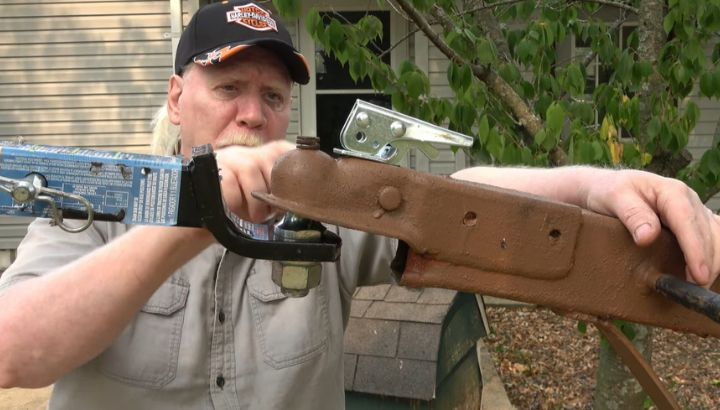
A trailer hitch coupler works by capturing a hitch ball inside a hollow socket, then locking a latch mechanism (jaw, clamp, or wedge) under the ball to prevent vertical separation. The ball provides a 360-degree pivot point so the trailer can turn, pitch, and roll independently of the tow vehicle while staying mechanically connected.
Tow vehicles and trailers behave as two separate rigid bodies that need a single articulating joint between them. The coupler-and-ball pairing is that joint. A 2-5/16 inch ball coupler on an 8,000 lb travel trailer turns through corners, pitches over driveway transitions, and rolls slightly on uneven pavement without ever transferring those forces back to the truck frame. To understand how does a trailer hitch coupler work, you have to picture a steel socket gripping a steel ball through a spring-loaded latch that resists every direction of pull except the one you want.
What Is A Trailer Hitch Coupler And What Does It Do?
A trailer hitch coupler is the steel socket assembly mounted to the front of a trailer’s A-frame that connects to the tow vehicle’s hitch ball. The coupler captures the ball, locks it in place with a latch mechanism, and provides a pivot point that allows the trailer to articulate independently of the tow vehicle during turning, pitching, and rolling movements.
This article covers conventional ball-and-coupler trailer hitch couplers specifically, not gooseneck couplers, 5th wheel kingpins, pintle ring couplers, or surge brake coupler assemblies. Each of those is a separate connection category with different geometry and load characteristics.
Trailer hitch couplers fall under the broader category of trailer connection hardware governed by SAE J684 hitch class standards and FMCSA cargo securement rules. The coupler size (1-7/8 inch, 2 inch, or 2-5/16 inch) is matched to the trailer’s gross weight rating and the hitch ball mounted on the tow vehicle.
The four main jobs of a trailer hitch coupler:
Captures the hitch ball mechanically. The coupler socket is precision-machined to fit a specific ball diameter (1-7/8 inch, 2 inch, or 2-5/16 inch) with about 0.005 inch clearance. The tight fit prevents the ball from slipping out under normal driving loads.
Provides 360-degree articulation. The spherical ball-in-socket geometry lets the trailer pivot freely in three axes: yaw (turning corners), pitch (driveway transitions and braking), and roll (uneven pavement). Without this pivot, the trailer and tow vehicle would lock together and any geometry change would crack the frame at one end or the other.
Transfers tongue weight to the hitch ball. The coupler bears the entire trailer tongue weight (typically 10-15% of gross trailer weight) onto the ball through the contact area inside the socket. The ball transfers the load down through the ball mount, into the receiver, and onto the tow vehicle frame.
Resists separation under driving loads. The latch mechanism keeps the coupler engaged with the ball during acceleration, braking, and side loads from cornering and crosswinds. Properly latched couplers do not separate even during emergency maneuvers.
The coupler also serves as the anchor point for the safety chains and the breakaway brake cable on trailers with electric brakes. Both of these are required by federal regulation and most state DMV laws on trailers over 1,500 lbs gross weight.
On my own utility trailer, I run a Bulldog 2-inch coupler rated for 5,000 lbs gross weight that connects to the 2-inch ball on my Ford F-250’s drop ball mount. The coupler has handled over 50,000 miles of loaded contractor hauling without any maintenance beyond annual grease.
The takeaway: a trailer hitch coupler is the articulating joint that connects two rigid vehicles into a single tow rig while letting them move independently through every direction of motion the road throws at them.
What Are The Main Parts Of A Trailer Hitch Coupler?
The main parts of a trailer hitch coupler are the coupler body (steel socket housing), the latch mechanism (jaw, clamp, or wedge), the locking pin or pin-and-clip assembly, the safety chain anchor points, and the mounting flange that bolts or welds to the trailer A-frame.
Here is a reference table of trailer hitch coupler components and their function:
| Component | Function | Typical Material | Notes |
|---|---|---|---|
| Coupler Body | Hollow socket that captures the ball | Forged or cast steel | Sized to specific ball diameter |
| Latch Mechanism | Locks the ball inside the socket | Spring-loaded steel | Jaw, clamp, or wedge design |
| Locking Pin or Pin-And-Clip | Secures the latch in closed position | Hardened steel | 1/4-inch or 5/16-inch typical |
| Hand Lever or Handle | Operator interface for latch | Forged steel with rubber grip | Lifts or slides to release |
| Safety Chain Loops | Anchor points for safety chains | Welded steel rings or hooks | One per side, federally required |
| Breakaway Cable Anchor | Attachment for trailer brake cable | Welded steel ring | Required on trailers with brakes |
| Mounting Flange | Bolts or welds to trailer A-frame | Steel plate | Bolt-on or weld-on configurations |
| Grease Fitting (Optional) | Lubrication access | Threaded steel | Some heavy-duty couplers only |
The coupler body is the structural heart of the entire connection. Forged steel couplers (Bulldog, Wallace Forge, Demco) provide higher strength than cast steel couplers at similar price points. The internal socket dimension is precision-machined to match the ball diameter within 0.005 inch.
The latch mechanism varies by manufacturer but always serves the same function: lock the ball inside the socket so it cannot escape vertically. Three common designs handle this differently.
Jaw-style latches use a sliding jaw that captures the ball under its widest diameter. Lifting the lever retracts the jaw, allowing the coupler to drop onto the ball or lift off. This is the most common design on bumper-pull trailers from Bulldog, Demco, and Wallace Forge.
Clamp-style latches use a hinged clamp that pivots up and over the ball, then locks down with a threaded screw or cam lever. This design appears on heavier trailers and some boat trailers because it provides tighter clamping pressure than jaw designs.
Wedge-style latches use a sliding wedge that drops down behind the ball and prevents rearward separation. This design appears on some European-spec trailers and specialty equipment haulers.
The locking pin or pin-and-clip assembly secures the latch in the closed position. Without the pin, road vibration could potentially release the latch and allow separation. The pin is the secondary safety device, with the safety chains being the tertiary backup if both the latch and pin fail.
Safety chain loops are required by federal regulation on trailers over 1,500 lbs gross weight. The chains cross under the coupler in an X-pattern so they can catch the trailer tongue if separation occurs. Properly installed chains let the tongue rest on them without striking the ground.
The breakaway cable anchor connects the trailer brake actuator’s safety cable to the tow vehicle. If the trailer separates while driving, the cable pulls a pin from the brake actuator and applies full trailer brake pressure until the actuator battery dies (typically 15-30 minutes).
On a job in Lakewood in 2023, I replaced a Bulldog 2-5/16 inch coupler on a customer’s 14,000 lb equipment trailer that had developed a cracked latch jaw after 8 years of service. The new coupler installed in 90 minutes with four bolts plus the safety chain re-routing. Total cost was $180 in parts plus 90 minutes of my time.
The takeaway: trailer hitch couplers are 5-8 component assemblies built around a precision-machined socket and a latch mechanism, with each component serving a specific safety function.
How Does The Coupler Latch Mechanism Actually Lock The Ball?
The coupler latch mechanism locks the ball by capturing it inside the socket and then sliding, pivoting, or wedging a steel jaw under the ball’s widest diameter (the equator). The jaw prevents vertical separation because the ball cannot pass back through the smaller opening at the socket throat once the jaw is engaged below it.
The locking principle is purely geometric. Hitch balls have a spherical shape with a maximum diameter at the equator (1-7/8 inch, 2 inch, or 2-5/16 inch depending on the ball size). The coupler socket has an opening at the throat that is slightly smaller than the ball’s equator.
When the coupler drops onto the ball, the ball passes through the throat opening into the larger socket cavity. The jaw, clamp, or wedge then engages below the ball’s equator, blocking the only path the ball could take to escape (back through the throat opening).
The jaw-style latch operates through three positions. The fully open position holds the jaw retracted and lets the ball pass freely in and out of the socket. The intermediate position partially blocks the throat opening so the ball can drop in but not lift back out. The fully closed position has the jaw fully engaged under the ball’s equator with the locking pin inserted to prevent accidental release.
The intermediate position is the safety feature that lets you test the latch before driving. Lower the coupler onto the ball with the latch in the open position, then move the handle to the closed position. Lift the trailer tongue by hand. If the coupler stays on the ball, the latch is engaged correctly. If the coupler lifts off, the latch did not engage and you need to re-seat the ball.
Spring tension keeps the jaw, clamp, or wedge in the closed position. A typical coupler spring provides 5-15 lbs of closing force on the latch mechanism, which is enough to keep the latch engaged through road vibration but light enough to allow easy hand operation.
The locking pin or pin-and-clip is the secondary safety device. The pin passes through the coupler body and the latch mechanism, physically preventing the latch from moving from closed to open without first removing the pin. Federal regulations and most state DMV laws require some form of latch securing device.
On my own 2020 Ford F-250 setup with a Bulldog 2-inch coupler on my utility trailer, I tested the latch engagement every time I hook up by lifting the trailer tongue 6-12 inches with the tongue jack after closing the latch. If the coupler stays engaged, the latch is locked correctly. If the coupler lifts off the ball, the latch did not catch and I re-seat before driving.
The takeaway: the coupler latch mechanism locks the ball by capturing it inside the socket and blocking the only escape path with a steel jaw or wedge, with spring tension and a locking pin providing redundant security.
What Sizes Of Trailer Hitch Couplers Are Available?
The three main sizes of trailer hitch couplers are 1-7/8 inch (light-duty utility trailers up to 2,000 lbs gross weight), 2 inch (most utility and boat trailers from 2,000-8,000 lbs gross weight), and 2-5/16 inch (travel trailers and heavy trailers from 8,000-20,000 lbs gross weight). Specialty sizes include 3 inch (heavy commercial trailers) and metric sizes (50mm) for imported equipment.
Here is a reference table of trailer hitch coupler sizes and their typical applications:
| Coupler Size | Ball Size Match | Trailer Gross Weight Range | Typical Applications | Receiver Class Required |
|---|---|---|---|---|
| 1-7/8 inch | 1-7/8 inch | 500-2,000 lbs | Small utility, jet ski, light boat trailers | Class I or II |
| 2 inch | 2 inch | 2,000-8,000 lbs | Utility, boat, lawn care, equipment trailers | Class II or III |
| 2-5/16 inch | 2-5/16 inch | 8,000-20,000 lbs | Travel trailers, large boat trailers, heavy equipment | Class III, IV, or V |
| 3 inch | 3 inch | 20,000-30,000 lbs | Heavy commercial trailers, fifth wheels with adapter | Class V or commercial |
| 50mm (1.97 inch) | 50mm | 2,000-7,000 lbs | European-spec trailers, imported equipment | Class II or III |
The coupler size selection depends entirely on the trailer’s gross weight rating, not on the tow vehicle’s receiver class.
1-7/8 inch couplers are the lightest duty option, used on small utility trailers, jet ski trailers, and lightweight boat trailers. The smaller ball provides less surface area for load distribution, which limits the maximum gross trailer weight to about 2,000 lbs.
2 inch couplers are the most common size on the US trailer market. The 2-inch ball provides adequate load capacity for most utility, boat, and lawn care trailers up to 8,000 lbs gross weight. Most hitch ball mounts include either a single 2-inch ball or a flip-over interchangeable ball that includes 2-inch capability.
2-5/16 inch couplers handle travel trailers, large boat trailers, and heavy equipment trailers from 8,000-20,000 lbs gross weight. The larger ball provides more surface area for load distribution and higher mechanical safety margin. Most travel trailers ship with 2-5/16 inch couplers as standard equipment.
3 inch couplers appear on heavy commercial trailers and some specialty applications. These require specialty ball mounts and are less common in consumer applications.
The critical point: the coupler size must match the ball size exactly. A 2-inch coupler on a 1-7/8 inch ball has 1/8 inch of vertical play that can cause the coupler to lift off the ball during braking or rough roads. A 1-7/8 inch coupler will not fit over a 2-inch ball at all.
On a job in Aurora in 2022, I helped a customer diagnose a recurring “trailer lifting off the ball” complaint on his 6,000 lb utility trailer. Inspection revealed his coupler was a 2 inch unit but he was using a 1-7/8 inch ball on his ball mount. The 1/8 inch undersize ball allowed enough vertical play that the coupler would lift slightly during sharp braking. Swapping to a proper 2 inch ball eliminated the problem.
The takeaway: trailer hitch coupler size must match the ball size exactly, with size selection driven by the trailer’s gross weight rating and the typical use case.
What Are The Main Failure Modes Of A Trailer Hitch Coupler?
The four most common trailer hitch coupler failure modes are cracked latch jaws from cyclic loading, worn socket interior from years of ball-to-socket contact, corroded latch mechanisms that prevent proper engagement, and bent or damaged coupler bodies from rear-end impacts or overloading.
The specific coupler failure modes I see most often after 16 years in the trailer industry:
Cracked latch jaws develop over 5-10 years of regular use as the jaw cycles through engagement and release thousands of times. The crack typically starts at a stress concentration point (a sharp internal corner or a casting flaw) and propagates outward.
A cracked jaw allows the ball to escape the socket during braking or sharp turns. The first symptom is usually a “popping” sound when the coupler is unloaded, followed by visible deformation of the jaw shape. Replace the entire coupler when any jaw crack is detected.
Worn socket interior develops over 50,000+ miles of regular use as the ball slides and rotates inside the socket. The factory-machined internal dimensions wear larger over time, creating vertical play between the ball and socket.
A worn socket allows the coupler to lift slightly off the ball during driving, which causes audible clunking on rough roads and increases the risk of latch failure during sharp braking. The fix is replacing the coupler with a new unit, which restores the factory clearance.
Corroded latch mechanisms develop on trailers stored outdoors in salt-belt states (Michigan, Ohio, Pennsylvania, upstate New York) or on boat trailers exposed to salt water. The corrosion locks the latch in the closed or open position and prevents normal operation.
The fix is penetrating oil, wire brushing, and periodic greasing of the latch pivot points. Severe corrosion may require coupler replacement. Annual maintenance with white lithium grease prevents most corrosion-related failures.
Bent or damaged coupler bodies happen from rear-end impacts (when something hits the parked trailer) or from overloading beyond the coupler’s rated gross trailer weight. The bent geometry prevents proper ball engagement and creates uneven loading on the latch mechanism.
The fix is full coupler replacement. Attempting to bend or hammer a damaged coupler back to original geometry is unsafe because the steel develops micro-cracks during the bending that cannot be detected visually.
A fifth failure mode worth mentioning is incorrect adjustment on adjustable couplers. Some couplers (Bulldog, Demco) include a clamp adjustment screw that compensates for socket wear over time. Failing to adjust the screw as the socket wears allows excessive ball-to-socket play.
On a job in Boulder last fall, I replaced a Bulldog 2-5/16 inch coupler on a 12,000 lb equipment trailer that had developed a cracked jaw after 9 years of contractor service. The crack was visible only when the jaw was fully open, and the customer had been towing for several months with the cracked component. The fix was a $190 replacement coupler installed in 90 minutes.
The takeaway: trailer hitch couplers fail predictably from cyclic loading, wear, corrosion, and impact damage, with regular inspection catching all four failure modes before they cause separation incidents.
Common Mistakes I See In Contractor Lots With Trailer Hitch Couplers
After 16 years in the trailer industry, here are the coupler mistakes I see most often on contractor job sites and DIY trailer setups.
The first mistake is skipping the engagement test after hooking up. Most contractors close the latch and assume it engaged correctly without verification. A 5-second tongue lift test using the jack confirms the latch caught the ball under its equator. Skipping the test causes most of the trailer separation incidents I have witnessed in 16 years.
The second mistake is mismatching coupler and ball sizes. A 2 inch coupler on a 1-7/8 inch ball allows vertical play that can lift the coupler off the ball during sharp braking. A 2-5/16 inch coupler will not engage at all on a 2 inch ball because the throat opening cannot capture the smaller ball. Always verify the coupler stamp and the ball stamp match before connecting.
The third mistake is ignoring socket wear over time. Couplers with 50,000+ miles of service develop measurable internal wear that increases ball-to-socket clearance. Annual measurement with a feeler gauge or visual inspection catches the wear before it causes audible clunking or latch failure.
The fourth mistake is using rusted or corroded balls on the tow vehicle. A heavily corroded ball has reduced effective diameter and rough surface texture that accelerates coupler socket wear. Replacing the ball ($15-$40) every 5-10 years preserves the coupler’s socket interior.
The fifth mistake is neglecting the safety chains and breakaway cable. Federal regulations require both on trailers over 1,500 lbs gross weight, but I see plenty of contractor trailers running with broken chains or missing breakaway cables. The chains and cable are the secondary and tertiary safety systems that prevent separation if the primary coupler latch fails.
On a job in Lakewood in 2021, I watched a contractor’s utility trailer separate from his Ford F-150 at 35 mph because he had not engaged the coupler latch after a quick hookup. The safety chains caught the trailer tongue and prevented it from striking the ground, but the experience scared the contractor enough that he now uses the tongue lift test on every hookup, every time. The chains saved his trailer, his bumper, and probably his life.
The takeaway: every coupler mistake is predictable and preventable with the tongue lift test, proper size matching, annual inspection, fresh ball hardware, and intact safety chains.
Frequently Asked Questions
How Do I Know If My Trailer Hitch Coupler Is Properly Engaged?
You know your trailer hitch coupler is properly engaged when the latch closes fully under spring tension, the locking pin slides through the latch cleanly, and the tongue lift test confirms the coupler stays on the ball. The lift test involves cranking the tongue jack up 6-12 inches after closing the latch. If the coupler stays engaged with the ball, the latch caught correctly.
If the coupler lifts off the ball during the test, the latch did not engage. Re-seat the ball and try again. Common causes of failed engagement include debris in the socket, a partially open latch handle, or a worn jaw that no longer captures the ball completely. Always perform the lift test on every hookup, every time, regardless of how many times you have hooked up the same trailer.
What Size Hitch Ball Do I Need For My Trailer Coupler?
You need a hitch ball that matches your trailer coupler size exactly. A 1-7/8 inch coupler requires a 1-7/8 inch ball, a 2 inch coupler requires a 2 inch ball, and a 2-5/16 inch coupler requires a 2-5/16 inch ball. The coupler size is stamped on the body of the coupler near the latch mechanism.
Using an undersize ball (e.g., 1-7/8 inch ball on a 2 inch coupler) creates vertical play that can lift the coupler off the ball during sharp braking. Using an oversize ball (e.g., 2 inch ball on a 1-7/8 inch coupler) prevents engagement because the larger ball cannot pass through the smaller socket throat. Always verify both stamps match before connecting.
How Often Should I Replace My Trailer Hitch Coupler?
You should replace your trailer hitch coupler when visible cracks appear on the latch jaw, when the socket interior shows excessive wear (more than 1/16 inch internal clearance beyond original), when the latch mechanism corrodes or seizes despite cleaning, or when the coupler body bends from impact or overloading. Most couplers last 10-20 years with regular use and proper maintenance.
Annual inspection catches wear and damage before they cause separation incidents. Look for visible cracks at the jaw pivot points, smooth latch operation through the full range of motion, and tight ball-to-socket engagement during the tongue lift test. Boat trailer couplers exposed to salt water typically need replacement every 5-10 years, while utility trailer couplers can last 15-20 years.
Can I Replace A Trailer Hitch Coupler Myself?
Yes, you can replace a trailer hitch coupler yourself if you have basic mechanical skills, a socket set with 17mm and 19mm sockets, a torque wrench, and 60-90 minutes of garage time. Most couplers attach to the trailer A-frame with four bolts that thread through pre-drilled holes. Removal involves unbolting the old coupler, sliding it off the A-frame, and bolting the new one in place.
For welded couplers, replacement requires cutting the old coupler off with a sawzall or angle grinder and welding the new one to the A-frame. This is a more advanced job that typically benefits from professional installation. Always verify the new coupler matches the original size, gross weight rating, and A-frame width before purchasing.
What Is The Difference Between A Trailer Coupler And A Trailer Ball?
A trailer coupler is the socket assembly mounted on the front of the trailer’s A-frame, while a trailer ball is the spherical steel ball mounted on the tow vehicle’s ball mount. The coupler captures the ball inside its socket and locks the ball in place with a latch mechanism. The ball provides the pivot point for trailer articulation.
The coupler and ball must be matched in size for proper engagement. Common pairings are 1-7/8 inch coupler with 1-7/8 inch ball (light-duty), 2 inch coupler with 2 inch ball (medium-duty), and 2-5/16 inch coupler with 2-5/16 inch ball (heavy-duty). The ball mounts to the tow vehicle through a ball mount shank that inserts into the hitch receiver tube.
How Much Does A Trailer Hitch Coupler Cost?
A trailer hitch coupler costs $40 to $250 for the coupler unit alone depending on the size, brand, and rating. Light-duty 1-7/8 inch couplers from generic brands run $40-$80. Mid-tier 2 inch couplers from Bulldog, Demco, and Wallace Forge run $80-$160. Heavy-duty 2-5/16 inch couplers run $150-$250 for premium forged steel units.
Installation labor adds $50-$150 if you have a professional trailer shop replace the coupler for you. DIY installation is straightforward on bolt-on couplers and saves the labor cost. Welded coupler replacement runs $200-$400 in labor due to the cutting and welding work required. Annual coupler inspection is free if you do it yourself and prevents most costly replacement scenarios.
The Bottom Line On How Does A Trailer Hitch Coupler Work
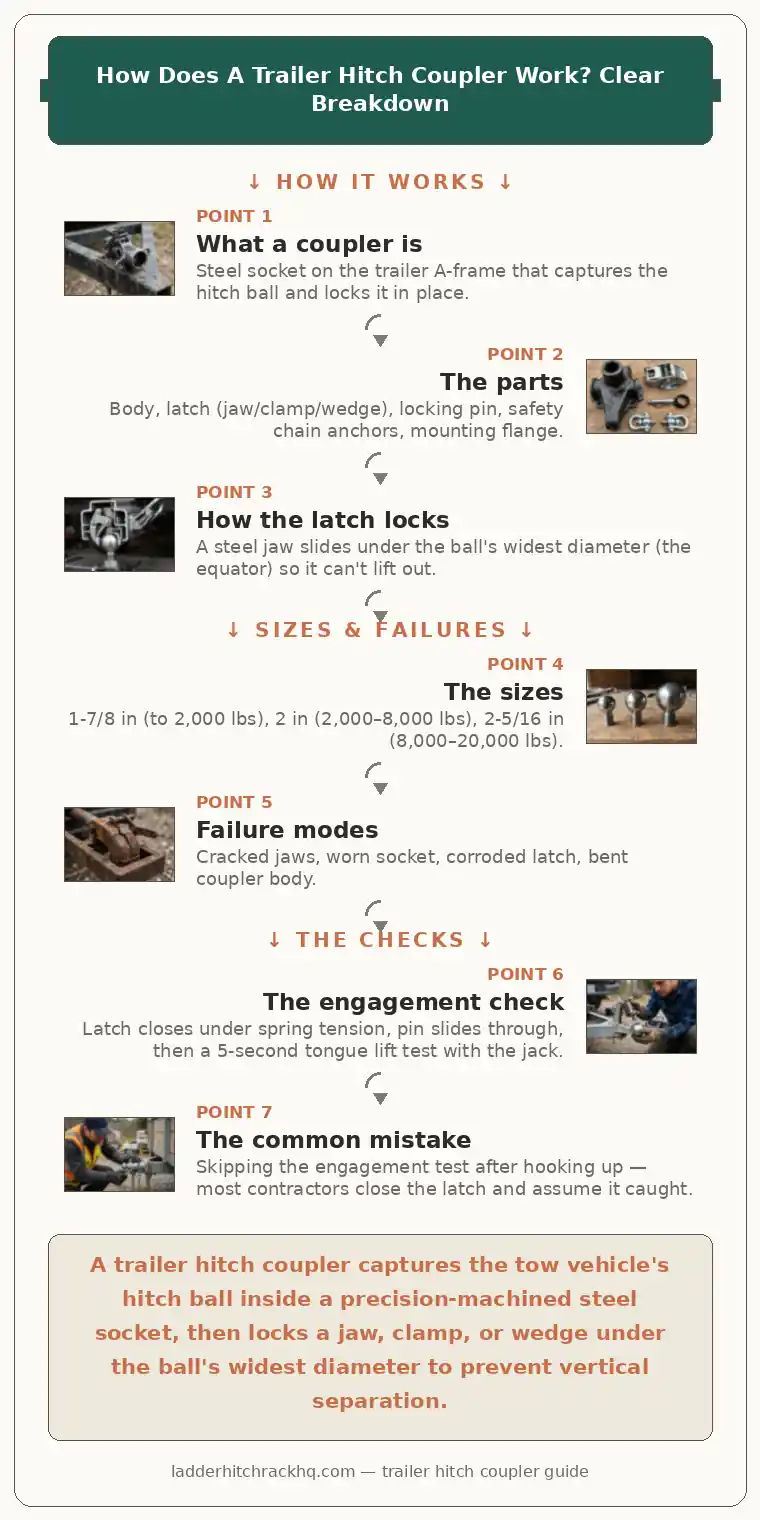
A trailer hitch coupler captures the tow vehicle’s hitch ball inside a precision-machined steel socket, then locks a jaw, clamp, or wedge under the ball’s widest diameter to prevent vertical separation. The ball-and-socket geometry provides 360-degree articulation so the trailer can turn, pitch, and roll independently while staying mechanically connected to the tow vehicle.
Match the coupler size (1-7/8 inch, 2 inch, or 2-5/16 inch) to the ball size exactly, verify engagement with the tongue lift test on every hookup, and inspect annually for cracked jaws, worn sockets, and corroded latches.
Choose Bulldog, Demco, or Wallace Forge for premium forged steel construction. Replace the coupler when visible cracks or excessive wear appear. Done right, a trailer hitch coupler lasts 10-20 years and provides the safest possible trailer connection.