By Dave Henderson, 16 years in the ladder hitch rack and hitch-mounted cargo carrier industry, founder of a contractor outfitting shop in Denver, hands-on experience installing and testing Thule, Kuat, Yakima, Hollywood, and 1Up USA bike racks on over 2,000 contractor and personal vehicles, daily driver of a 2020 Ford F-250 with a Kargo Master Pro III hitch rack.
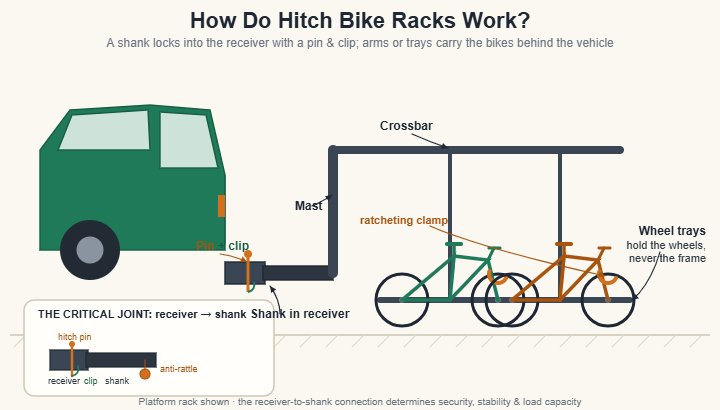
Hitch bike racks work by inserting a steel or aluminum shank into a vehicle’s 1.25-inch or 2-inch trailer hitch receiver, locking the shank with a hitch pin and retention clip, then holding bikes either by the frame (hanging racks) or by the wheels (platform racks) on arms extending behind the vehicle.
The receiver tube provides the structural mounting point, the hitch pin secures the connection, and the rack arms or trays cradle the bikes for transport. Premium racks include built-in anti-rattle mechanisms (Thule AutoAttach, Kuat HitchLock) that eliminate the 1/2 to 3/4 inch tolerance gap between the shank and receiver, while budget racks require an aftermarket anti-rattle pin. Understanding how do hitch bike racks work starts with the receiver-to-shank connection because that single joint determines security, stability, and load capacity.
What Are The Main Parts Of A Hitch Bike Rack?
The main parts of a hitch bike rack are the shank (1.25-inch or 2-inch steel tube that inserts into the receiver), the hitch pin and retention clip (secures the shank), the crossbar or mast (vertical structure supporting bike arms), the bike-holding mechanism (arms for hanging racks, trays for platform racks), the locking and anti-theft hardware, and the tilt or fold mechanism for trunk access.
This article covers hitch-mounted bike racks specifically, not roof-mounted bike racks, trunk-mounted strap-on bike racks, or spare-tire-mounted bike racks. Each of those is a separate product category with different mounting mechanics and load characteristics.
Hitch bike racks fall under the broader category of hitch-mounted cargo carriers regulated by SAE J684 hitch class standards. The shank-to-receiver connection is the structural foundation that determines what tongue weight the rack can safely carry.
Here is a reference table of major hitch bike rack components and their mechanical function:
| Component | Function | Common Materials | Typical Specs |
|---|---|---|---|
| Shank | Inserts into receiver tube | Powder-coated steel | 1.25″ or 2″ square, 7-9″ long |
| Hitch Pin | Locks shank to receiver | Hardened steel | 5/8″ diameter standard |
| Retention Clip | Prevents pin walk-out | Spring steel hairpin | 1.5-2″ length |
| Crossbar / Mast | Vertical support structure | 11-gauge or 14-gauge steel | 24-36″ tall |
| Bike Arms (Hanging) | Cradle bike top tubes | Steel with rubber pads | 4 arms standard |
| Wheel Trays (Platform) | Hold bike wheels horizontally | Aluminum or steel | 18-22″ per tray |
| Wheel Clamps (Platform) | Secure front wheel | Aluminum with ratchet | Adjustable 1-3″ |
| Tilt Mechanism | Folds rack down for trunk access | Steel hinge with locking pin | 30-90 degree tilt |
| Anti-Rattle System | Eliminates receiver-to-shank play | Threaded wedge or knob | Built-in or aftermarket |
| Locking Cylinder | Anti-theft protection | Stainless steel with key | One-Key compatible |
The shank is the foundation of every hitch bike rack. A 2-inch square shank fits Class III, IV, and V receivers, while a 1.25-inch shank fits Class I and II receivers.
The receiver tube manufacturing tolerance is wider than most owners realize. SAE J684 standards allow Class III receivers to measure 2.00 to 2.04 inches inside the tube, while bike rack shanks are manufactured at 1.97 to 1.99 inches to ensure fit. That 0.02 to 0.04 inch gap is what creates the side-to-side sway most racks suffer from at highway speeds.
The crossbar or mast determines load capacity and rack rigidity. An 11-gauge steel crossbar flexes about 40% less than a 14-gauge crossbar under a 200 lb load, which is why premium racks like the 1Up USA Heavy Duty and Kuat NV 2.0 use thicker steel than budget racks like the MaxxHaul 70210.
The bike-holding mechanism varies by rack type. Hanging racks use arms that cradle the bike’s top tube, while platform racks use trays that hold the wheels with ratcheting clamps. Platform racks are mechanically more secure because they clamp the bike at two points (front wheel plus tray strap) versus the single contact point of a hanging rack.
The takeaway: hitch bike racks consist of 7 major components that work together as a system, with the shank-to-receiver connection being the single most critical mechanical interface.
How Does The Receiver-To-Shank Connection Work?
The receiver-to-shank connection works through a four-step mechanical engagement: the shank slides into the receiver tube, the pin holes align, the hitch pin passes through both holes, and the retention clip locks the pin in place. Anti-rattle hardware fills the manufacturing tolerance gap to prevent sway.
This connection is the mechanical heart of every hitch-mounted bike rack and the source of most rack-related complaints.
The shank insertion is a slip-fit by design. The shank measures slightly smaller than the receiver tube to ensure it fits any vehicle within the SAE J684 tolerance range. A 2-inch Class III shank measures 1.97-1.99 inches across, while the receiver tube measures 2.00-2.04 inches across.
The pin hole alignment confirms full insertion. Both the shank and the receiver tube have 5/8-inch holes drilled at matching positions. When the holes line up, the shank is fully seated. Misalignment of more than 1/8 inch means the shank is not fully inserted, usually due to receiver tube corrosion or debris.
The hitch pin provides the primary structural connection. A standard 5/8-inch hardened steel pin passes through both holes and prevents the shank from sliding out of the receiver. The pin handles the rearward force from braking and the side-to-side force from turning, but does nothing to address the tolerance gap.
The retention clip prevents pin walk-out. A hairpin clip or R-clip slides through a small hole in the far end of the pin and prevents vibration from working the pin loose. Premium racks replace the clip with a One-Key locking cylinder that adds anti-theft protection. A missing retention clip is the single most common cause of hitch bike rack failure at highway speed.
The anti-rattle hardware fills the tolerance gap. Premium racks include built-in systems like the Thule AutoAttach knob or the Kuat HitchLock that drive a wedge against the receiver wall. Budget racks require an aftermarket device like the Andersen Rapid Hitch tightener ($45), the StableLoad ($25), or the Yakima HitchLock ($35).
On my own Kuat NV 2.0 4-bike platform rack on my wife’s 2019 Subaru Outback (factory Class III receiver, 350 lb tongue weight rating), I installed an Andersen Rapid Hitch tightener that dropped the side-to-side play at the rack tip from 5/8 inch to roughly 1/16 inch. The rack has been completely rattle-free for 5 years.
The takeaway: the receiver-to-shank connection works through pin insertion plus clip retention plus anti-rattle compression, and all three steps must be present for the rack to perform as designed.
How Do Hanging Hitch Bike Racks Work?
Hanging hitch bike racks work by suspending bikes from their top tubes on arms that extend behind the vehicle. The rack base inserts into the receiver, the vertical mast supports the load, and the cradle arms hold each bike by the horizontal top tube using padded contact points and rubber straps.
Hanging racks are the original hitch bike rack design and remain popular for budget and occasional-use applications.
The Allen Sports Deluxe 4-Bike (1.25″/2″ shank, $80-$120) is the entry-level hanging rack and dominates the budget tier. The Thule Apex XT 4 (1.25″/2″ shank, $200-$300) is the premium hanging rack with anti-sway features. The Saris Bones EX (1.25″/2″ shank, $200-$300) uses molded plastic construction for compact storage.
The mechanical principle is simple. The bike hangs by its top tube on cradle arms that pivot to accommodate different frame geometries. Foam pads or rubber sleeves protect the frame from contact damage. Adjustable straps secure each bike to its arm to prevent swinging during transit.
The capacity limit comes from the cantilever moment arm. A 4-bike hanging rack extends 24-30 inches behind the receiver pin, and 4 bikes at 30 lbs each create roughly 100-150 ft-lbs of bending force on the rack-to-receiver connection. This is why hanging racks max out at 4 bikes and typically require a Class II or III receiver minimum.
The major mechanical limitations of hanging racks are the inability to safely carry carbon-frame bikes (top tube stress concentration), the inability to carry women’s step-through frames or full-suspension mountain bikes (no horizontal top tube to grip), and the bike-to-bike contact during transit (frames swing into each other on rough roads).
I lost a $1,400 Trek Fuel EX 5 full-suspension mountain bike on a hanging rack in 2017 when the second bike’s pedal scraped through the first bike’s brake line. The fix was switching to a platform rack with dedicated wheel trays that separate the bikes. I never used a hanging rack for mountain bikes again.
The takeaway: hanging hitch bike racks work by suspending bikes from the top tube on cradle arms, which is mechanically simple and budget-friendly but limited in bike compatibility and protection.
How Do Platform Hitch Bike Racks Work?
Platform hitch bike racks work by holding each bike on a horizontal tray that supports both wheels, with a ratcheting front wheel clamp and a rear wheel strap securing the bike to the tray. The trays attach to a horizontal crossbar that pivots from the vertical mast inserted into the receiver.
Platform racks dominate the premium tier of the hitch bike rack market and are now the most common choice for serious cyclists.
The Kuat NV 2.0 (2″ shank, $700-$900) is the gold-standard platform rack with integrated wheel clamps, cable locks, and the HitchLock anti-rattle system. The Thule T2 Pro XTR 2 (2″ shank, $650-$850) uses the AutoAttach knob and AcuTight torque system. The 1Up USA Heavy Duty Double (2″ shank, $600-$800) is the overbuilt option with virtually zero documented failure rate.
The mechanical principle separates platform racks from hanging racks. Each bike sits on a dedicated tray that holds the front and rear wheels at fixed positions. The front wheel clamp ratchets down to grip the tire (not the frame), which spreads the load across the wheel rim rather than concentrating it on a single contact point.
The clamping mechanism varies by manufacturer. Kuat uses an aluminum front-wheel hook that ratchets down with a smooth-glide system. Thule uses the AcuClamp arm with a soft-touch contact pad. 1Up USA uses an EZ-Pull lever that compresses both wheels simultaneously.
The capacity is higher than hanging racks because the load distributes across the tray rather than concentrating at one contact point. A 4-bike platform rack like the Kuat NV 2.0 with the add-on extension safely handles 60 lbs per bike (e-bike compatible), while a 4-bike hanging rack maxes out at 35-40 lbs per bike.
The major mechanical advantages of platform racks are universal bike compatibility (carbon, full-suspension, e-bikes, women’s frames all fit), no bike-to-bike contact (trays separate the bikes by 12+ inches), easier loading at waist height (no overhead lift), and integrated tilt-away mechanisms for trunk access without removing bikes.
The mechanical disadvantage is the higher cost ($400-$1,000 versus $80-$300 for hanging racks) and the heavier empty weight (35-65 lbs versus 12-30 lbs for hanging racks). On Subaru Outback fuel economy testing, a loaded Kuat NV 2.0 dropped MPG by 1.2 mpg, while a comparable hanging rack with the same bikes dropped MPG by 0.8 mpg.
The takeaway: platform hitch bike racks work by holding each bike on a dedicated tray with ratcheting wheel clamps, which is mechanically superior for security and compatibility but adds cost and weight.
How Do Vertical Hitch Bike Racks Work?
Vertical hitch bike racks work by suspending bikes vertically from a horizontal beam that extends behind the vehicle, with each bike hanging by its front wheel from a hook or cradle. The mast inserts into the receiver, the horizontal beam extends rearward, and 4-6 bikes hang vertically in a tight cluster.
Vertical racks are the newest hitch bike rack design and are popular for mountain bike shuttle trips and trail access vehicles.
The Yakima HangOver 4 (2″ shank, $700-$900) is the leading vertical rack with steel cradles. The Velocirax 4 (2″ shank, $900-$1,300) uses fold-down cradles for compact storage. The Recon Gen 3 (2″ shank, $800-$1,100) is the premium aluminum-construction option.
The mechanical principle saves rear length compared to platform racks. By orienting bikes vertically, the rack reduces the rear extension from 60-72 inches (platform 4-bike) to 24-36 inches (vertical 4-bike). This matters for tight parking lots, dense urban driving, and shuttle vehicles that need to fit standard parking spaces.
The bike-holding mechanism uses padded steel cradles or rubber-coated hooks that grip the front tire. The bike hangs vertically with the rear wheel close to the ground, supported by a wheel chock or hanging strap that prevents swinging.
The capacity is higher than platform racks per square foot of receiver space. A vertical 6-bike rack fits 6 mountain bikes in the same rear extension as a 4-bike platform rack. The Yakima HangOver 4 carries 4 bikes at 37.5 lbs each (150 lbs total) plus the 65 lb rack for a total tongue weight of 215 lbs.
The major mechanical advantage is mountain bike compatibility. Vertical racks were designed specifically for full-suspension mountain bikes with awkward frame geometry, fat tires, and dropper posts. Road bikes with thin tires and aero handlebars do not fit as cleanly because the front wheel hook is sized for 2.0-3.0 inch mountain bike tires.
The disadvantage is bike compatibility outside mountain bikes. Road bikes, cyclocross bikes, gravel bikes, and kids’ bikes with smaller wheel diameters often do not fit the standard front-wheel hook geometry. Verify your bike fits before buying a vertical rack.
The takeaway: vertical hitch bike racks work by hanging bikes vertically from a front-wheel hook, which maximizes capacity in tight spaces but limits compatibility to mountain bike geometry.
What Mechanical Failures Happen To Hitch Bike Racks?
The four most common mechanical failures are pin walk-out at highway speed, cracked welds at the shank-to-crossbar joint, bent receiver tubes from rear-end collisions, and overloaded racks beyond the per-bike weight limit causing arm or tray failure.
The specific mechanical failure modes I see in 16 years of hitch rack work:
Pin walk-out is the most common catastrophic failure. The hitch pin vibrates loose without a retention clip and exits the receiver tube. The rack drops onto the receiver lip, the bikes hit the pavement, and the rack drags until the driver notices. Prevention is a hairpin clip on every pin, every trip.
Cracked welds at the shank-to-crossbar joint develop over 18-36 months of regular use on budget racks with 14-gauge or thinner steel. The MaxxHaul 70210, Tyger Auto TG-RK4B102B, and similar value-tier racks fail here. Premium racks like the Kuat NV 2.0, Thule T2 Pro XTR, and 1Up USA Heavy Duty use 11-gauge steel or thicker and rarely crack at this joint.
Bent receiver tubes happen when a rear-end collision strikes the rack while mounted. The collision energy transfers into the receiver tube and bends the geometry, making the rack rattle excessively after the impact. Receiver replacement is the only fix.
Electric bike overload is the newest failure mode. E-bikes weigh 50-80 lbs each, double the weight of analog bikes. A 4-bike platform rack with a 35 lbs per-bike limit cannot safely carry 4 e-bikes at 65 lbs each. The cradle arms bend, the trays warp, and the bikes shift during transit.
On a Colorado mountain trip in 2022, I watched a friend’s MaxxHaul 70210 4-bike rack fail at the right crossbar weld after 20 months of regular use. The crack ran along the heat-affected zone next to the weld bead. Two bikes dropped at 45 mph. The bikes were destroyed, the rack was scrap, and the only saving grace was no other vehicles were behind us.
The takeaway: every hitch bike rack mechanical failure traces back to a specific cause (missing clip, undersized steel, collision, overload), and all four are preventable with proper rack selection and inspection.
Frequently Asked Questions
What Class Hitch Do I Need For A Hitch Bike Rack?
You need a Class I or II receiver (1.25-inch opening, 200-350 lbs tongue weight) for 1-2 bike hanging racks like the Allen Sports Deluxe 2-bike or Thule Apex XT 2. You need a Class III receiver (2-inch opening, 500-600 lbs tongue weight) for any 4-bike platform rack like the Kuat NV 2.0 or Thule T2 Pro XTR.
For 6-bike vertical racks or e-bikes weighing 60-80 lbs, a Class IV receiver (2-inch opening, 800-1,200 lbs tongue weight) is the safer choice. Verify your receiver class rating stamped on the side of the receiver tube before purchasing. Overloading past the rated capacity stresses receiver welds and can damage the vehicle frame at the mounting points.
How Do I Know If My Hitch Bike Rack Is Secure?
Check your hitch bike rack security with the rack-tip shake test. Grab the rack at the tip (farthest from the vehicle) with no bikes loaded and shake it firmly side to side, up and down, and front to back. Side-to-side play should measure under 1/16 inch with zero audible rattle when an anti-rattle pin is properly installed.
Stock receiver tube tolerance produces 1/2 to 3/4 inch of natural play, which is the wobble most riders feel at highway speed. A threaded anti-rattle hitch pin like the Andersen Rapid Hitch tightener, StableLoad, or Yakima HitchLock eliminates this play. Also verify the hitch pin retention clip is fully seated to prevent pin walk-out under vibration.
Can Hitch Bike Racks Damage My Vehicle?
Hitch bike racks generally do not damage your vehicle under normal loading conditions as long as the tongue weight stays under the receiver class rating. A Class III receiver rated for 500 lbs tongue weight handles a typical 4-bike platform rack and bikes (200-300 lbs total) with substantial margin remaining.
The bigger damage risk is from rear-end collisions with the rack still mounted. The collision energy transfers directly into the receiver tube, bending the tube geometry and distorting the mounting plates. Always check the receiver after any rear impact. Bike-to-vehicle contact during sharp braking can also damage paint, especially on platform racks that fold close to the tailgate without proper clearance.
How Long Do Hitch Bike Racks Last?
A quality hitch bike rack lasts 10-20 years with regular use and proper storage. Premium racks built with 11-gauge steel or thicker (Kuat NV 2.0, Thule T2 Pro XTR, 1Up USA Heavy Duty) typically outlast the vehicles they mount on. Budget racks with 14-gauge steel (MaxxHaul, Tyger Auto, Allen Sports) typically last 3-7 years before crack failures appear at the weld joints.
Inspect your hitch bike rack monthly for visible cracks at the shank-to-crossbar joint, weld discoloration, paint chipping that exposes raw steel to rust, and worn bike-contact pads. Replace immediately if any structural damage is found. A new Type IA quality platform rack costs $400-$1,000, which is far cheaper than the consequences of a rack failure at highway speed.
Do I Need An Anti-Rattle Pin For My Hitch Bike Rack?
Yes, you need an anti-rattle pin for any hitch bike rack that does not include a built-in anti-rattle system. Premium racks like the Thule T2 Pro XTR (AutoAttach knob) and Kuat NV 2.0 (HitchLock system) include factory anti-rattle hardware. Budget racks like the MaxxHaul 70210, Allen Sports Deluxe, and Tyger Auto ship with a basic 5/8-inch hitch pin and require aftermarket anti-rattle hardware.
The Andersen Rapid Hitch tightener ($45), StableLoad ($25), and Yakima HitchLock ($35) are the leading options. All three thread into the receiver tube and apply pressure against the rack shank, reducing the typical 1/2 to 3/4 inch of side-to-side play to under 1/16 inch. The aftermarket pin pays for itself the first time you eliminate highway-speed rack sway.
Are Hitch Bike Racks Better Than Roof Or Trunk Racks?
Hitch bike racks are mechanically better than roof or trunk racks for most use cases. Hitch racks load at waist height (no overhead lifting), secure bikes more rigidly than friction-based trunk racks, accommodate heavier e-bikes up to 80 lbs per bike, and preserve overhead clearance for garages and drive-thrus.
The trade-off is the upfront cost of a trailer hitch installation if the vehicle does not have one ($300-$600 turnkey). For vehicles that already have a factory hitch (most modern SUVs and pickups), a hitch-mounted platform rack is almost always the better long-term choice. Trunk racks and roof racks work for budget setups or vehicles without hitches, but each has documented limitations in security, capacity, and ease of use.
The Bottom Line On How Do Hitch Bike Racks Work
Hitch bike racks work by inserting a steel shank into a 1.25-inch or 2-inch trailer hitch receiver, locking the shank with a hitch pin and retention clip, and holding bikes on arms (hanging racks) or trays (platform racks) that extend behind the vehicle.
Platform racks (Kuat NV 2.0, Thule T2 Pro XTR, 1Up USA Heavy Duty) are mechanically superior to hanging racks because they clamp bikes by the wheels rather than stressing the top tube. The receiver-to-shank tolerance gap causes the wobble most riders feel, and an anti-rattle pin like the Andersen Rapid Hitch tightener eliminates it.
Verify your receiver class matches your loaded rack weight, install the retention clip every trip, and inspect monthly for weld cracks. Done right, a quality hitch bike rack lasts 10-20 years of trouble-free service.